

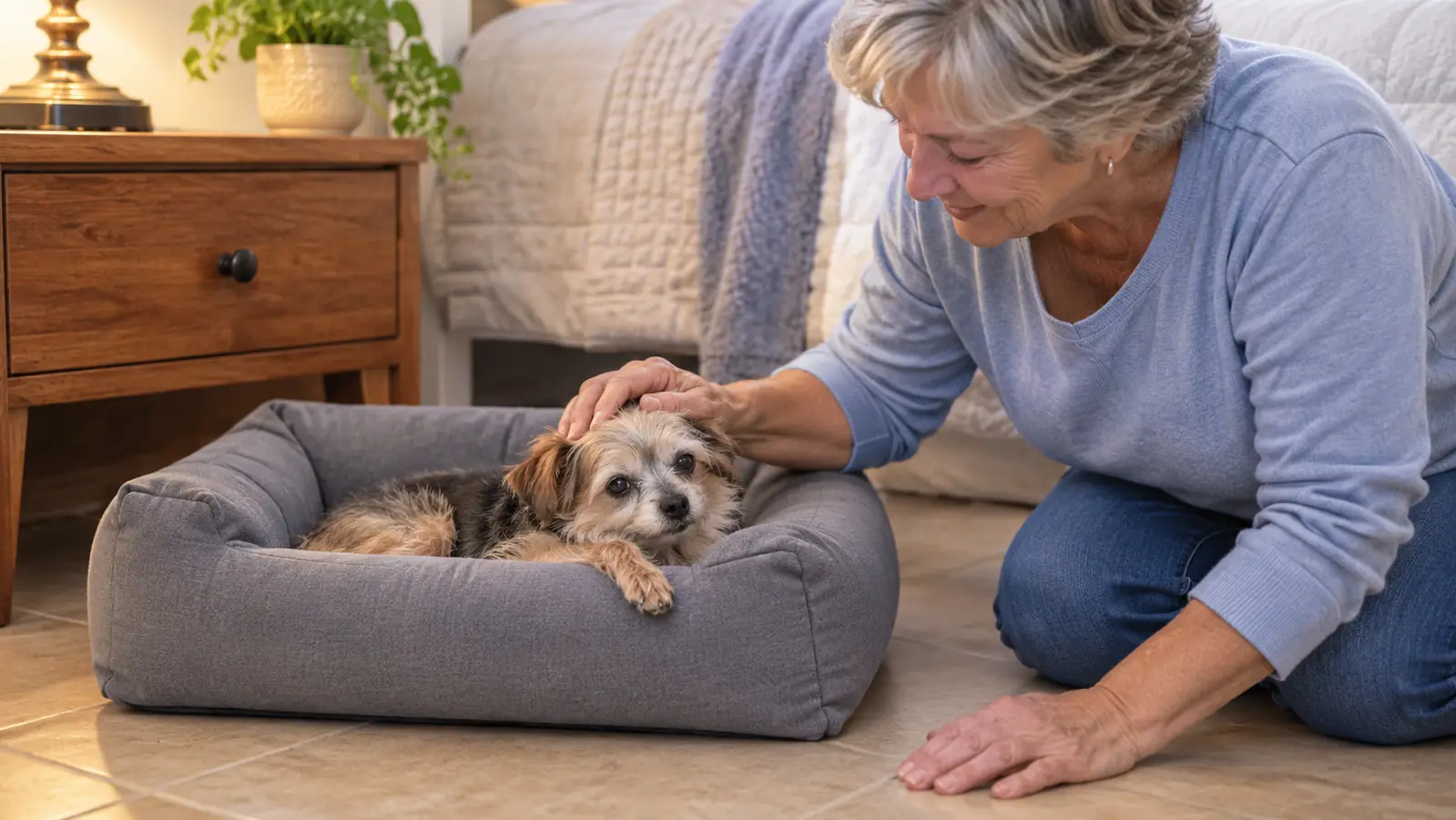
Pepper is thirteen years old, six pounds, and stiff in the back legs every single time he gets up from a nap. For about a year he slept on a flat fleece pad on the floor on my side of the bedroom, and for about a year I told myself that was fine. Small dog, small bed, no problem. Then one morning in January he stood up in stages. Front legs first. A pause long enough that I looked over from the dresser. Then the back legs, one at a time, with a hitch in the left one where the kneecap slides.
The pad was a quarter inch of polyester between his hips and a tile floor, and tile in Tucson is cold in the morning no matter what the calendar says. In January I swapped it for the Bedsure orthopedic dog bed for small dogs, and the change in how he stands up is the only reason I am writing any of this down. A supportive bed for an arthritic small dog is a different purchase from a bed for a young dog. You are not buying something cute. You are buying something that keeps his hips off a hard floor, that he can get into and out of without a running start, and that you can wash, because old dogs have accidents and nobody warns you about that part.
The bed that finally got Pepper off the fleece pad
Orthopedic foam, bolsters on four sides, a cover that unzips for the wash and a waterproof layer under it. Three nights for him to accept it. Two weeks before the mornings changed.
Amazon Check Today's Price on Amazon →Step 1: Measure the dog and the floor, not the product photo
Two numbers matter before anything else: his weight and his length from the base of the tail to the front of his chest while he is standing. Pepper is six pounds and a little over a foot long when he stretches out. Then read the weight limit on the listing instead of assuming it. The Bedsure is listed with a maximum weight recommendation of 10 pounds, which leaves a small dog real margin and leaves a 20 pound dog out entirely. If your dog is over that number, do not buy this one and hope. Size up.
The second measurement is floor. The footprint is 23.62 by 17.72 inches and it stands 5.91 inches tall, which is taller than it sounds when it is sitting next to a nightstand. I moved a laundry basket to make room. Measure the spot where the bed will actually live, not the spot where you would like it to live, because a bed that has to be shoved aside every night ends up in a closet by March. Measure the doorway too if he follows you from room to room.
One more thing about measuring: watch him lie down on the bare floor. A dog with hip arthritis tends to circle twice and lower himself with his back legs splayed out to one side rather than tucked under. That sprawl takes more floor than a curled sleep, which is why a bed that fits a young dog in a ball can leave an old dog with a hip hanging over the edge. Pepper sprawls to the left, every time. The rectangle gives him the room to do it.
Step 2: Read what is inside the cover, because the foam is the whole job
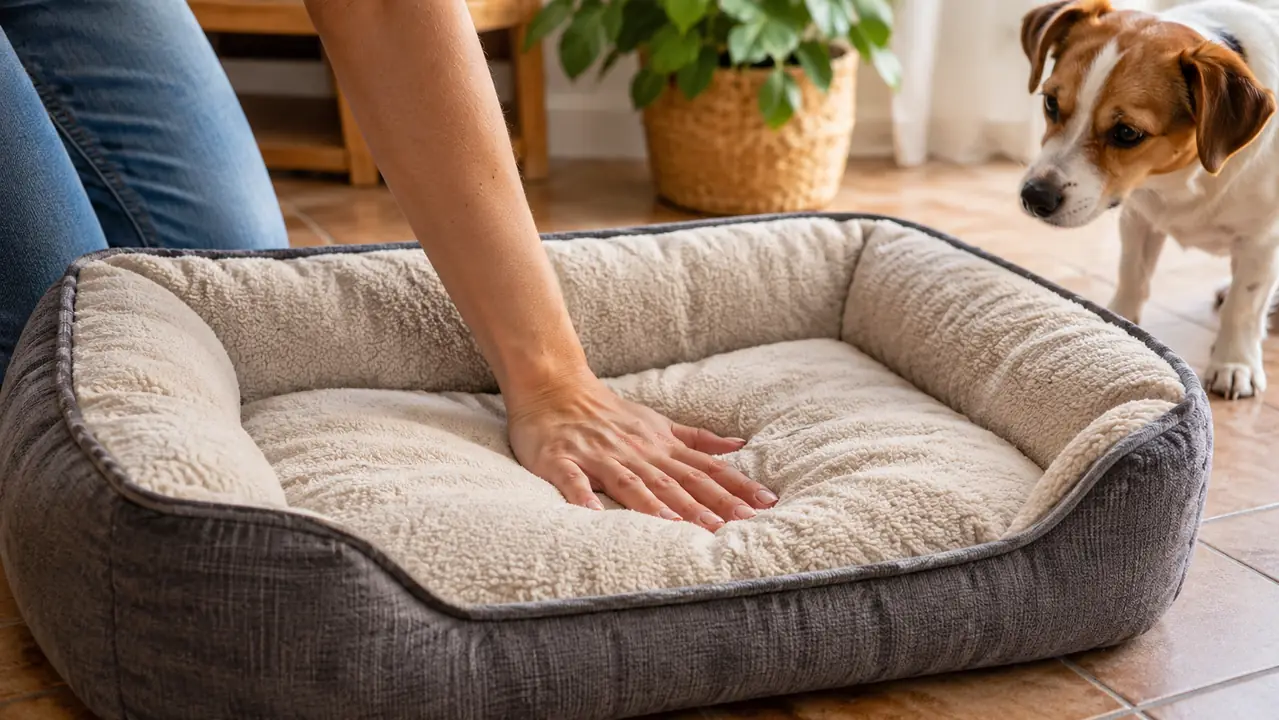
Orthopedic is not a regulated word on a pet listing. A manufacturer can print it on anything with a little thickness. What you can actually check is the fill, the certifications, and what the foam does when you press the middle of the bed with a flat hand. The Bedsure lists polyurethane foam with a CertiPUR-US certification, a polyester cover, and materials certified to OEKO-TEX Standard 100. Those are the two lines I look for, because they are earned rather than written.
Press the center. If your fingertips find the floor through the foam, a six pound dog's hip will find it too, just slower, over a few months. The foam on this bed holds up under Pepper, and he has been on it about ten months, which is long enough for a cheap fill to have flattened into a mat. It has not, though there is a visible dip where he lands every night, and I expect that dip to deepen before I expect it to go away.
Be careful with the height number as well. The 5.91 inches includes the bolsters, so do not read that as six inches of foam under his hips. This is a low profile bed. For a six pound dog that is the right height, because he steps in without a ramp or a lift, but it also means a heavier dog would bottom it out. The breed recommendation is small and the 10 pound limit is not a suggestion. It is the design.
Step 3: Watch how he gets in, because a bolster can be a wall
The Bedsure has bolsters on four sides. That is good for one thing and inconvenient for another. The good part is that Pepper gets his front paws up on the side bolster and pushes off it when he stands, which gives him something to brace against instead of scrabbling at flat fabric. The inconvenient part is that there is no lowered front and no little cut-out doorway, so getting in means stepping over that bolster every time. Some mornings he stands there, looks at it, and waits for me to lift him in.
That is the honest tradeoff, and it is the main reason I would tell you to watch your own dog before you decide. If he still steps over a six inch edge on his own, four bolsters are a comfort. If he is past that, or if his back legs are weaker than Pepper's, look for a bed with a low front or a hinged side instead of this one. I am not going to pretend the bolster is not there just to make the purchase sound simpler.
What I did about it was put the bed against the wall on one side so he has a single open approach instead of four, and I kept the old fleece pad on the floor beside it for the first week so he had somewhere familiar to land if he changed his mind. He changed his mind twice. Then he stopped. If your dog is stiff and stubborn both, give him the option and let him take it on his own schedule.
Step 4: Check the laundry before you check anything else
Nobody tells you about the accidents. Old dogs do not always wake up in time, and a dog with hip arthritis takes longer to get his back end organized than he used to. In the first month, Pepper wet the bed twice. In a bed with a sewn-on cover, that is a ruined bed. The Bedsure has a removable cover with a waterproof layer underneath, which is the detail that made the decision for me and the one I would not buy a senior dog bed without.
The cover unzips and goes in the wash. I do it every two weeks whether it needs it or not. The foam itself does not go in the machine. I spot it with a damp cloth and let it air out in the shade on the patio, never in full Tucson sun, and I turn the foam over when the clean cover goes back on so it wears evenly. That whole routine takes about twenty minutes and it is the difference between a bed that lasts and a bed that smells.
The waterproof layer is the part that actually protects the purchase. Water goes through a fabric cover in seconds. The barrier underneath is what keeps the foam from turning into a wet sponge that never quite dries, which is how a bed starts to smell and how you end up carrying it out to the curb after four months. Removable, waterproof and easy to clean is not a fancy set of features. It is basic maintenance for an old dog, and it belongs on your checklist above anything cosmetic.
Step 5: Give it three nights and two weeks, and judge the mornings
The first night, Pepper slept on the fleece pad next to the new bed. The second night he got in and got out twice. The third night he stayed. That was January, and the cover has come off and gone back on a couple dozen times since. If your dog takes a week, that is normal. If he will not use it after ten days and he is avoiding the room entirely, the bed is in the wrong place, or there is something going on worth asking your vet about.
Judge the mornings, not the sleep. Sleeping on anything soft looks the same from across the room. What changed here was the standing up. For the first two weeks I did not see much. By the end of the second week he was up on the first try more often than not, with less of that long pause at the back end. Ten months in, that is still where we are. Some mornings are slow. The ones after a cold night are the slowest.
What did not change is the arthritis and the loose left kneecap. Dr. Salazar diagnosed both when Pepper was twelve, and a bed does not touch either one. The bed keeps his hips off cold tile for eight hours a night. That is the whole claim. It is a good claim and it is not the same thing as treatment. If your dog has a diagnosis, a bed is a comfort measure to bring up with your vet, not a replacement for the conversation.
Three nights before he would lie down on it. Two weeks before the mornings got easier. The kneecap is still loose, and the bed never pretended otherwise.
What Else Helps
The bed is one piece of a routine, and on its own it would not be enough. Tile is the real enemy in this house, so Pepper wears grip socks indoors for a few hours in the morning and again in the evening, and I check his paws every day when they come off. The sofa has a set of foam stairs sitting on the area rug so he is not jumping. The one step down to the back patio gets the lift harness on bad mornings, about twice a week. None of that is dramatic. It is all just friction removed, one piece at a time.
Inside the body, he gets one Cosequin soft chew every morning with breakfast, broken into two pieces, at the amount Dr. Salazar set for his size. He has been on it about a year and the first change I noticed came around week six, when he stopped taking quite so long to rise from a nap. Follow the label and your own vet on dose rather than copying mine. Weight matters more than any of it. Six pounds is six pounds, and I work to keep it there.
The other thing that helps is patience, and I am not being sentimental. An old dog does not want to be hurried through a doorway or scooped up under the belly, which Pepper dislikes and will tell you about. He wants sure footing, a slow ten to fifteen minute walk before the heat, and a soft place to land at the end of it. The bed is the soft place. The rest is routine, and routine is what an arthritic dog can count on.
If your old dog is still sleeping on a pad, start here
23.62 by 17.72 inches, foam underneath, bolsters on four sides, cover off for the wash. Ten minutes to set up. Give him three nights before you decide he hates it.
Amazon Check Today's Price on Amazon →