
Pepper is 13, a Yorkshire Terrier who weighs about 6 pounds, and he has reached the stage where the sofa is no longer a piece of furniture. It is a cliff. He stands at the base with his back legs stiff, looks up, and does the math. Dr. Salazar diagnosed mild arthritis in his hips and a loose left kneecap when he was 12. For a while he could still make the jump if he got a running start. Then one evening in April 2026 he misjudged it, came down wrong, and yelped. That sound stayed with me. I am Marlene, not a veterinarian, just a retired dental office manager in Tucson who has had small dogs most of her life. I bought a set of COZY KISS dog stairs the next week.
Before that, I did what a lot of owners do. I lifted him. I stacked a folded blanket on the floor, which he ignored. I told myself he would learn to stay off the couch, and then I watched him sit on the rug looking at it. Lifting him was not the end of the world, but he dislikes being scooped under the belly, and my own back is 63 years old. What he needed was a way to get up on his own four feet, with sure footing and no jump. The stairs gave him that. They did not make him young again. They made the sofa reachable, which was the whole job.
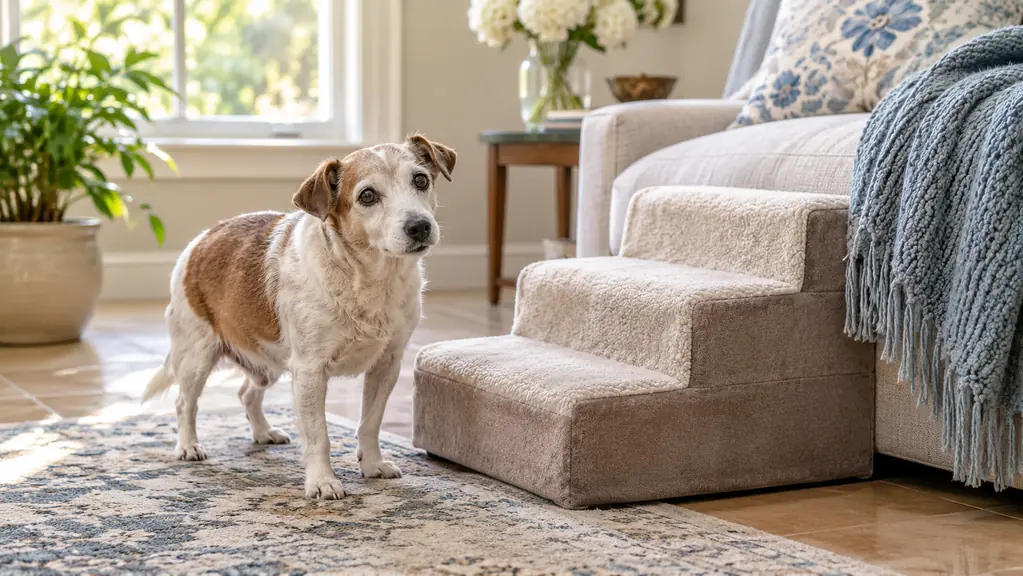
The three-step foam stairs that gave Pepper a way up without a jump
These are the stairs Pepper uses every evening. Three steps, 15.7 inches high, foam, and light enough to move when I vacuum. They sit on the living room rug against the sofa.
Amazon Check Today's Price on Amazon →Step 1: Measure the sofa before you buy any stairs
Start with a tape measure, not a guess. A sofa seat is not the same height as a chair seat, and a bed is taller still. The COZY KISS listing lays it out plainly: two layers are for chairs, three layers are for sofas or couches, four layers are for beds, and five layers are for higher beds. Pepper's sofa is a standard couch, so the three-step model was the right match. The three-step is 15.7 inches high, 22.4 inches long, and 15.7 inches wide. Those numbers mattered to me because our living room is not huge and I did not want a piece of furniture that ate the floor.
Measure the height from the floor to the top of the sofa cushion, then measure the floor space where the stairs will sit. You want the top step to meet the cushion without a gap and without a lip that the dog has to climb over. You also want enough room at the base for the dog to stand before he starts up. For Pepper, the top step sits just below the cushion. He can step up, not launch up. That is the difference between a dog using the stairs and a dog avoiding them.
The brand matters less than the fit, but I will say this: I looked at the COZY KISS dimensions because they were listed clearly, and I could compare them to my sofa before I ordered. If the numbers do not match your furniture, keep looking. A set of stairs that is too short makes the jump worse. A set that is too tall takes up half the room. Measure first, then buy.
Step 2: Put the stairs on a rug and against the sofa
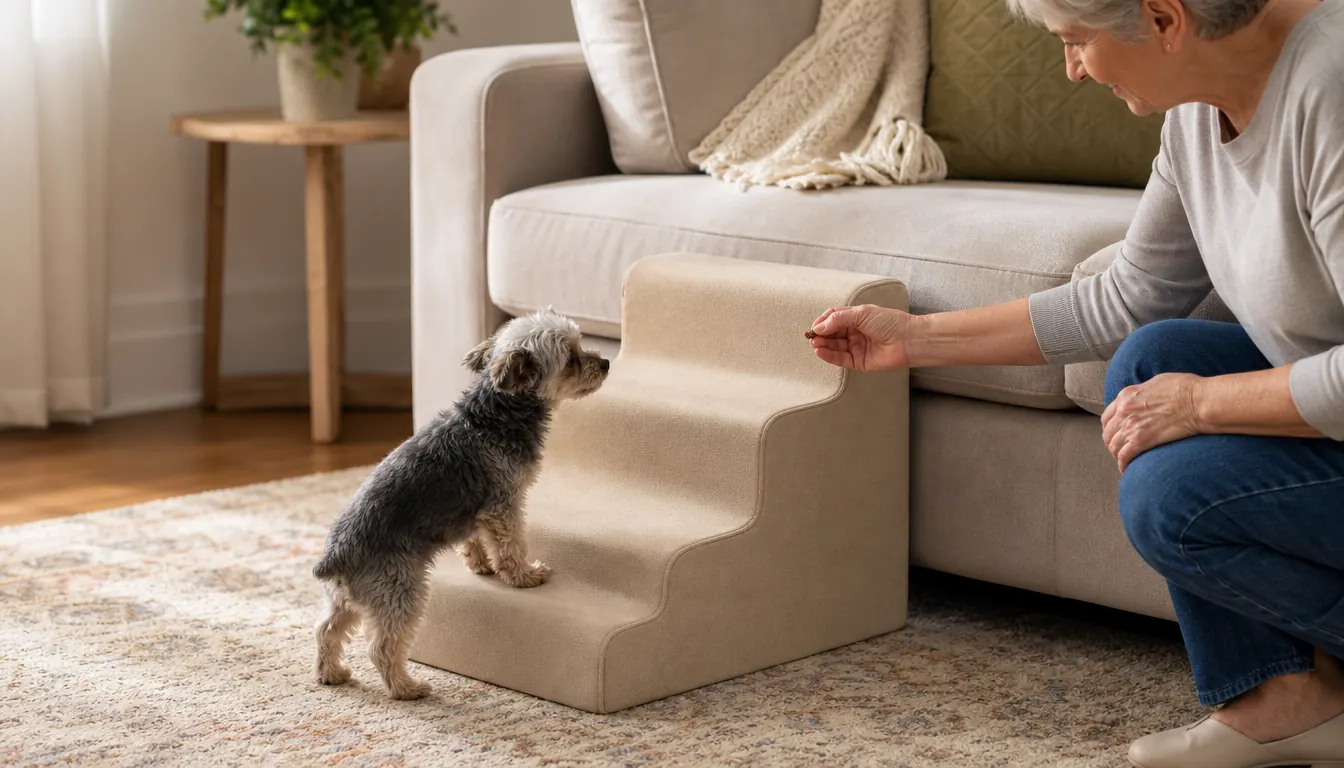
Pepper's stairs live on the one area rug in the living room, pushed against the sofa. That is not decoration. Our house is tile throughout, and foam on tile can slide when a 6 pound dog pushes off it. On the rug, the base stays put. If you have hardwood or tile, put the stairs on a non-slip rug or a mat, and check that the base is not resting on a rug edge that can curl. The stairs should not wobble when you press on the top step with your hand.
Place the top step tight to the sofa cushion. A gap invites a leap, and a leap is what we are trying to avoid. The front edge of the stairs should be clear so the dog can approach straight on. Do not put the stairs in a corner where the dog has to turn sideways to start up. Pepper approaches from the front, puts one front paw on the first step, then brings his back legs up. That motion is easier when he has a straight line.
This is also where the COZY KISS stairs earned their place in our house. They are light enough that I can move them to vacuum, but they are stable when they are set down. I check the position every few days because Ray sometimes bumps them when he walks past. A quick nudge back against the sofa takes two seconds. If the stairs slide or tip, stop and fix the placement before you ask the dog to use them.
Step 3: Give the foam 24 to 48 hours to expand
The stairs arrive vacuum packed. The listing says it takes 24 to 48 hours to return to its original shape, and that was true for us. Ours took about a day and a half to fill out. Do not judge the stairs in the first hour. They look thin and sad right out of the package, like a folded cushion. Set them in a warm room, open the packaging, and let them sit. Do not put a dog on them while they are still compressed.
The foam is high density sponge, and the listing says it supports up to 80 pounds. Pepper is 6 pounds, so weight is not the issue. The issue is shape. A fully expanded step has a flat top and a firm edge. A half-expanded step is soft and uneven, and a senior dog will feel that. I waited the full day and a half, then pressed on each step with my hand. When the foam felt even, I put the stairs in place.
The stairs are light and easy to carry, which is useful if you want to move them from the living room to a chair. They are for indoor and outdoor use according to the listing, but I keep ours inside. I vacuum the surface and keep the foam dry. The listing also carries a 6 month manufacturer warranty. I have not needed it, but it is there.
Step 4: Teach one step at a time with treats and patience
Pepper did not run up the stairs the first day. He looked at them, looked at me, and walked away. That is normal. I put a treat on the first step and let him take it. Then a treat on the second step. Then the third. We did this for about 10 days, a few minutes at a time, usually in the evening when he was already awake and the house was quiet. He learned the stairs on his own schedule.
The mistake I almost made was rushing him. I wanted him to use the stairs that night. He is 13, he is stiff after naps, and he has a loose kneecap in his left back leg. A dog like that does not need a cheerleader. He needs a clear path and a reason to try. I used small pieces of chicken and kept my voice low. When he put a paw on the first step, I did not clap or grab him. I let him finish the treat and come back down.
If your dog refuses, stop and try again later. Do not pick him up and place him on the top step to show him how it works. That teaches him the stairs are something that happens to him. Let him investigate the base, sniff the steps, and walk away. Try again after a nap or after a walk. If he yelps, limps, or seems painful, call your veterinarian before you keep going. I am not a vet, and a senior dog with arthritis needs a real exam, not a guess from me.
Step 5: Make the stairs part of a daily routine and watch for trouble
Pepper uses the stairs in the evening, when we settle on the sofa for a women's college basketball game. He also uses them in the morning if he wants up while I am drinking coffee. The stairs are for the sofa only. Our bed is too tall for this model, so he does not sleep on the human bed. He sleeps on his orthopedic bed on the floor on my side of the bedroom. That arrangement has been the same since January 2026.
A routine helps because it removes the decision. He knows the stairs are how he gets up, and he knows I am nearby. I keep the path clear. I do not leave laundry on the lower steps. I check that the stairs are against the sofa before I sit down. If he hesitates at the base, I put a treat on the first step and let him choose. If he has a slow day, I do not force it. He still has arthritis and the loose kneecap. The stairs are a tool, not a cure.
Watch for the things that mean the stairs are not working. If he starts avoiding the sofa altogether, if he slips on the way up, if he cries when he pushes off, or if he seems worse the next day, stop and call Dr. Salazar. A senior dog can develop a new problem in a week. The stairs are safe for what they are, but they cannot fix a dog who is in pain. I would rather make a vet appointment than watch Pepper struggle.
What Else Helps
The stairs are one piece of a bigger routine. Pepper takes Cosequin for Small Dogs, one chew every morning with breakfast, broken in two pieces. That is the amount Dr. Salazar set for his size, and I am not telling you to copy it. Follow the label and your own vet. The label carries glucosamine, chondroitin, MSM and omega-3s, so he does not get another joint supplement. We started in November 2025, right after the diagnosis. The first small change came around week six to eight: less stiffness getting up from naps. It did not fix the loose kneecap, and it did not bring back jumping.
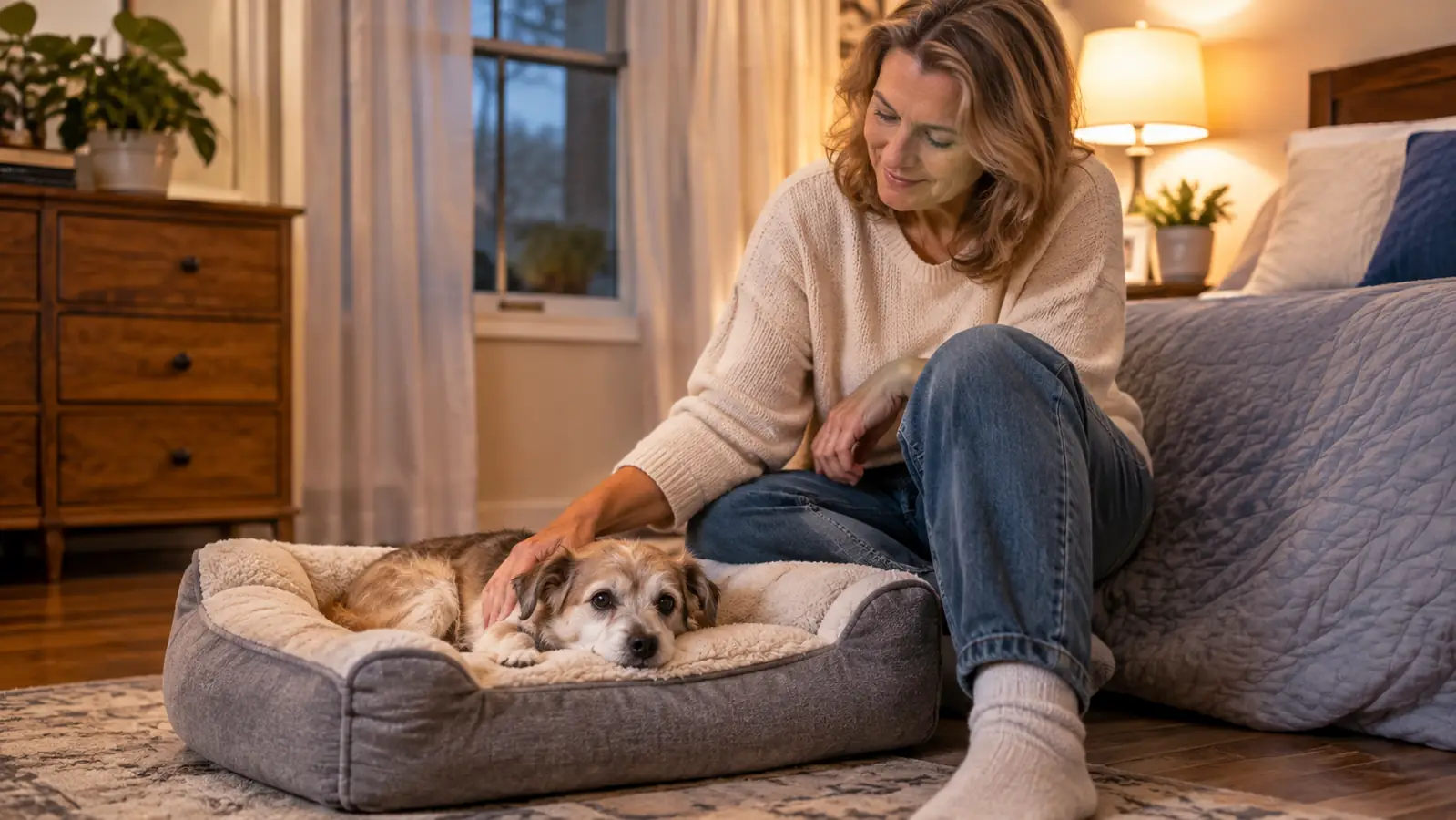
His bed is a Bedsure orthopedic bed, 24 by 18 by 6 inches, with bolsters on four sides. It lives on the floor on my side of the bedroom. We bought it in January 2026. It took him about three nights to give up the old fleece pad, and over about two weeks he got up a little easier in the morning. The cover is removable and washable, and I wash it every two weeks. That bed and the stairs do different jobs: the bed is for sleep, the stairs are for the sofa.
On the tile, he wears DOK TigerToes grip socks. We bought them in March 2026 after his back legs splayed in the kitchen. I measured his paw at home and bought extra small. He high stepped for about a week, then forgot them. He wears them indoors for a few hours in the morning and in the evening, never overnight and never on walks. I check his paws every day when they come off. For the one step down to the back patio, I use a PICK FOR LIFE lift harness on bad days, about twice a week. It holds up his back end, and I cinch the drawstring almost all the way because it is roomy on a 6 pound dog. It is not a daily thing. It is for the mornings when his back legs are stiff and I do not want him to scramble.
The COZY KISS stairs are the part that gave him back the sofa. The rest of the routine keeps him comfortable enough to use them. None of it cured anything. He is still old. He still has arthritis and the loose left kneecap. He still has slow days. But he can get up on the couch without a jump, and that is a good evening in our house. Check with your veterinarian before you start a supplement or change an exercise routine, especially with a diagnosed condition.
Ten days of treats, one step at a time, and Pepper stopped looking at the sofa like it was a cliff. The stairs did not make him young. They made the sofa reachable without a jump.
If your dog still looks at the couch like a cliff, start with the fit
Measure the seat, put the stairs on a rug, let the foam expand, and teach one step at a time. The COZY KISS three-step model is the one Pepper uses for the sofa. Check the dimensions against your own furniture before you order.
Amazon Check Today's Price on Amazon →