

It started with a sound. Pepper is a six pound Yorkshire Terrier, thirteen years old, and after a nap he would push himself up off the fleece pad and let out a small huff, and his back legs would take a beat longer than the rest of him to agree to the plan. Not a yelp. Not a limp. Just a delay, the kind you can talk yourself out of noticing for a few months.
I talked myself out of it for a while. He was old, I was old, and everything takes a beat longer than it used to. What changed my mind was the morning he stood at the kitchen door and looked at the one step down to the patio the way you look at a curb in the dark. Dr. Salazar, our vet here in Tucson, found mild arthritis in his hips and a loose kneecap in his left back leg in November 2025 and suggested a joint supplement. That is how we ended up with Cosequin for Small Dogs, the soft chews, made by Nutramax Laboratories. One chew every morning with breakfast, about twelve months now. I am not a vet and this is not medical advice. But I have done this for a year with a very small, very old dog, and there are things I wish someone had told me in week one instead of week thirty.
The container I wish I had bought in week one instead of week three
Cosequin for Small Dogs soft chews, 45 count, from Nutramax Laboratories. One chew with breakfast. Set the amount with your own vet for your own dog's size, then give it two months before you decide anything.
Amazon Check Today's Price on Amazon →Step 1: Get the diagnosis before you get the container
Supplements are not a diagnosis and they do not replace one. A loose kneecap and arthritis and a soft tissue strain can all look identical from the doorway of the kitchen, and they do not have the same answer. What I paid for at that first visit was not a pill. It was a baseline: which leg, which joint, how much range of motion, what Dr. Salazar could feel with her hands that I could not see from across the room. She also watched him walk on the tile and then on the rug, and the difference between those two surfaces told her more than anything I could have described out loud.
Ask the boring questions while you are in the room. Is this a joint problem, a weight problem, or a nail problem? Is there anything about this particular dog that makes a supplement a bad idea? What amount do you want for this size dog, and do you want me to split the chew? Write the answers in the car before you drive home, because you will not remember them by Thursday, and Thursday is when you will be standing in the pet aisle with your phone in one hand.
One more thing about size. Pepper has been six pounds and change for years, so weight was never our lever. For a lot of small senior dogs it is the lever, and it costs nothing but attention. A pound on a six pound dog is a bigger percentage than five pounds on a Labrador. If your dog has quietly rounded out since he stopped jumping onto things, that is worth a conversation before you buy anything at all.
Step 2: Match the supplement to the dog, not to the problem
Small dog formulas are not a marketing gimmick. The chew size and the amount are scaled for a small mouth and a small body, and a chew the size of a half dollar is not a treat to a six pound dog, it is a project. Cosequin for Small Dogs comes as a soft chew in a 45 count container, which at one chew a day works out to a little over six weeks. That math matters, because you are going to be buying this on a schedule whether you plan for it or not, and you may as well know the schedule.
The label on the container lists glucosamine hydrochloride, sodium chondroitin sulfate, MSM and omega-3 fatty acids, and the soft chew is the only form we have used. That combination is the reason Pepper takes one thing and not three. Without it I would have been measuring glucosamine from one container, chondroitin from a second, and something separate for his coat, and I would have gotten the amounts wrong within a week. The listing also says Nutramax Laboratories has been at this for over twenty five years and that Cosequin is the top vet recommended retail joint supplement brand, which is the sort of claim I usually skip past. What I can tell you is that our own vet named it without being asked, and that carries more weight with me than a badge on a label.
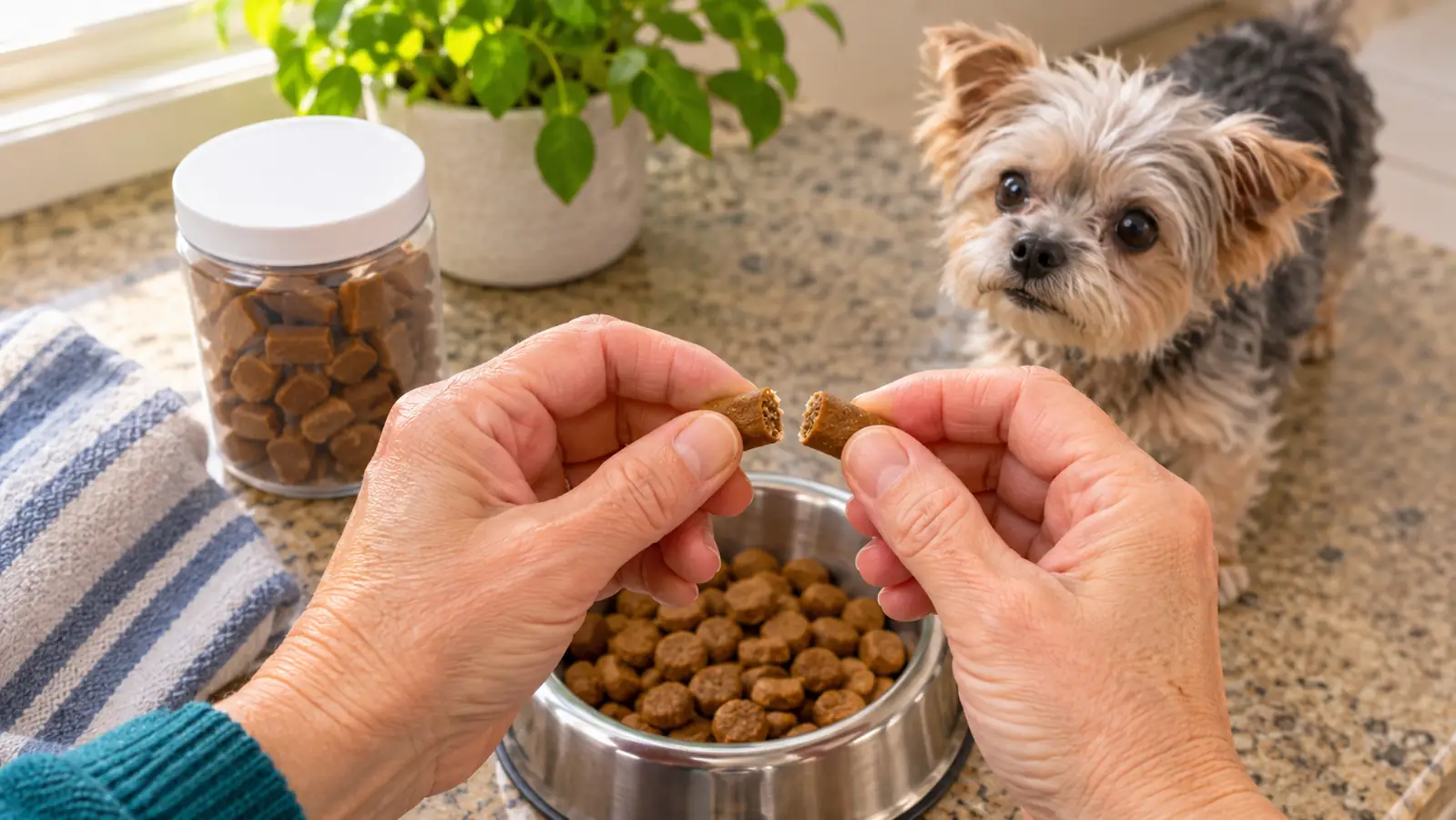
Follow the label and your vet's number, not mine. Dr. Salazar set Pepper's amount for his size, and I break the chew into two pieces so he chews it instead of gulping it whole. What is right for a six pound thirteen year old is not automatically right for a twelve pound nine year old, and it is not right at all for a dog on other medication until a vet says so. The container lists fish as an allergen, which is worth knowing if your dog has ever reacted to fish based food. Read the back of the container yourself. It takes two minutes and it is your dog.
Step 3: Make it part of breakfast, not part of a campaign
The fastest way to make a supplement fail is to turn it into a project. I put the container in the kitchen cabinet next to the coffee, and the chew goes on top of his kibble in the same stainless bowl at the same time every morning. He does not get a vote, and he does not get to skip a day because I am running late or because we have an early appointment.
Pepper is not a picky dog, so I got lucky. If yours is, break the chew smaller and mix it into something he already loves, and then step away from the bowl instead of standing over him watching, because a dog can feel a performance. If he refuses it three mornings in a row, stop and call your vet rather than forcing it. You do not want to teach an old dog that breakfast is a negotiation, because you will lose that argument for the rest of his life.
Consistency is the entire trick. In twelve months I have missed maybe three days, all of them while we were traveling. The calendar on the fridge gets a small check mark each morning, and that check mark is the whole system. It is not sophisticated. It does not need to be. A supplement that gets given four days out of seven is a supplement you cannot evaluate, because you will never know whether the thing worked or whether you just ran out of momentum.

Step 4: Write down what you actually see
Here is where I would push back on most supplement reviews, including mine. Memory is a liar. By week ten you will not remember whether he was worse in March than he is now, and you will be tempted to credit whatever you bought most recently. So write it down. Four lines in a notebook by the phone: how he got up from a nap, how the walk went, whether he used the stairs, and whether there was anything new. It takes about twenty seconds.
What I actually recorded: weeks one through five, nothing. Same huff, same delay, same look at the patio step. Week six, maybe week eight, less of a production getting up off the pad. I want to be careful here, because this is the part where a review turns into a commercial. It was a small improvement, in one specific movement, on a dog who was still thirteen and still arthritic and still finished with jumping.
That is the honest shape of it, and I think it is the shape most owners will see if they give it two months and keep notes. It did not fix the loose kneecap. It did not put him back on the sofa under his own power. If you are waiting for a supplement to do those things you will be disappointed, and you will blame the chew for something it never promised in the first place. Set your checkpoint at eight weeks, not eight days.
Week six, maybe week eight. He got up off the pad without the huff. Not a transformation. Just less of a production, and it held for ten months.
Step 5: Fix the floor before you buy a second container
A supplement works from the inside, and it works slowly. The house works from the outside and it works in an afternoon. If you can only do one thing this month, do the house, because the house is what keeps a small senior dog from getting hurt while the supplement is still catching up. That is the advice I would give you before I would give you a product name.
Our order of operations, in case it is useful. An orthopedic bed in January, because the flat fleece pad on the floor was not doing anything for his hips and he was starting every day stiff. Grip socks in March, after his back legs splayed on the kitchen tile and he scrambled like a cartoon on ice. Foam stairs in April, after he misjudged a jump at the sofa and yelped. A rear lift harness in June, for the one step at the kitchen door on the bad mornings.
None of that is a supplement and all of it mattered. Tile is hard and slick, and a six pound dog with a loose kneecap has almost no margin on slick. The bed sits on the floor on my side of the bedroom. The stairs live on the living room rug against the sofa so they cannot slide, and they are for the sofa only, because our human bed is too tall for them. The harness holds up his back end about twice a week, not daily, and it replaced scooping him under the belly, which he has always hated. He still gets carried out to the car, one hand under the chest and one under the rear, and that has not changed and probably will not.
What Else Helps
Gentle daily movement, on a surface with grip. Pepper gets a slow ten to fifteen minute walk around the block early, before the Tucson heat makes the sidewalk a griddle, and that is the whole exercise program. No jogging, no fetch on tile, no heroic weekend hikes to make up for a quiet week. An old dog does better with a small amount every day than a large amount once, and the small amount is also the thing you can actually keep doing in July.
Nails short. This is unglamorous and it matters more than people think. A long nail changes how a dog stands and shifts the whole foot back, and on a dog with a bad knee that is a tax on every single step he takes. Whatever schedule gets you there, get there, and if you cannot do it yourself, pay someone who can.
Warmth and a soft landing. A senior small dog loses muscle in his rear, and muscle is what cushions a joint. A warm spot out of a draft and a bed that supports him instead of letting him sink is not a luxury item for a thirteen year old. And patience. Eight weeks is the earliest honest checkpoint for a joint supplement, and eight weeks is a long time when you are watching every morning for something to change.
Check back in with your vet. Ours wants to see Pepper every six months now, which felt excessive the first time and now feels about right. A supplement is one piece of a plan, and the plan is the thing that gets a small old dog through his last few years with some dignity. No product reversed Pepper's arthritis. Nothing stopped him from getting older. He is still stiff after naps and he still does not jump, and he is still, on most days, a fairly content little dog who gets a walk, a warm spot, and a women's basketball game on the television. That is the goal I would set for you. Not a younger dog. A comfortable one.
One container, one chew, one check mark on the calendar
Cosequin for Small Dogs soft chews, 45 count, from Nutramax Laboratories. Set the amount with your own vet for your own dog's size, give it eight weeks, and keep the notes. That is the whole method.
Amazon Check Today's Price on Amazon →