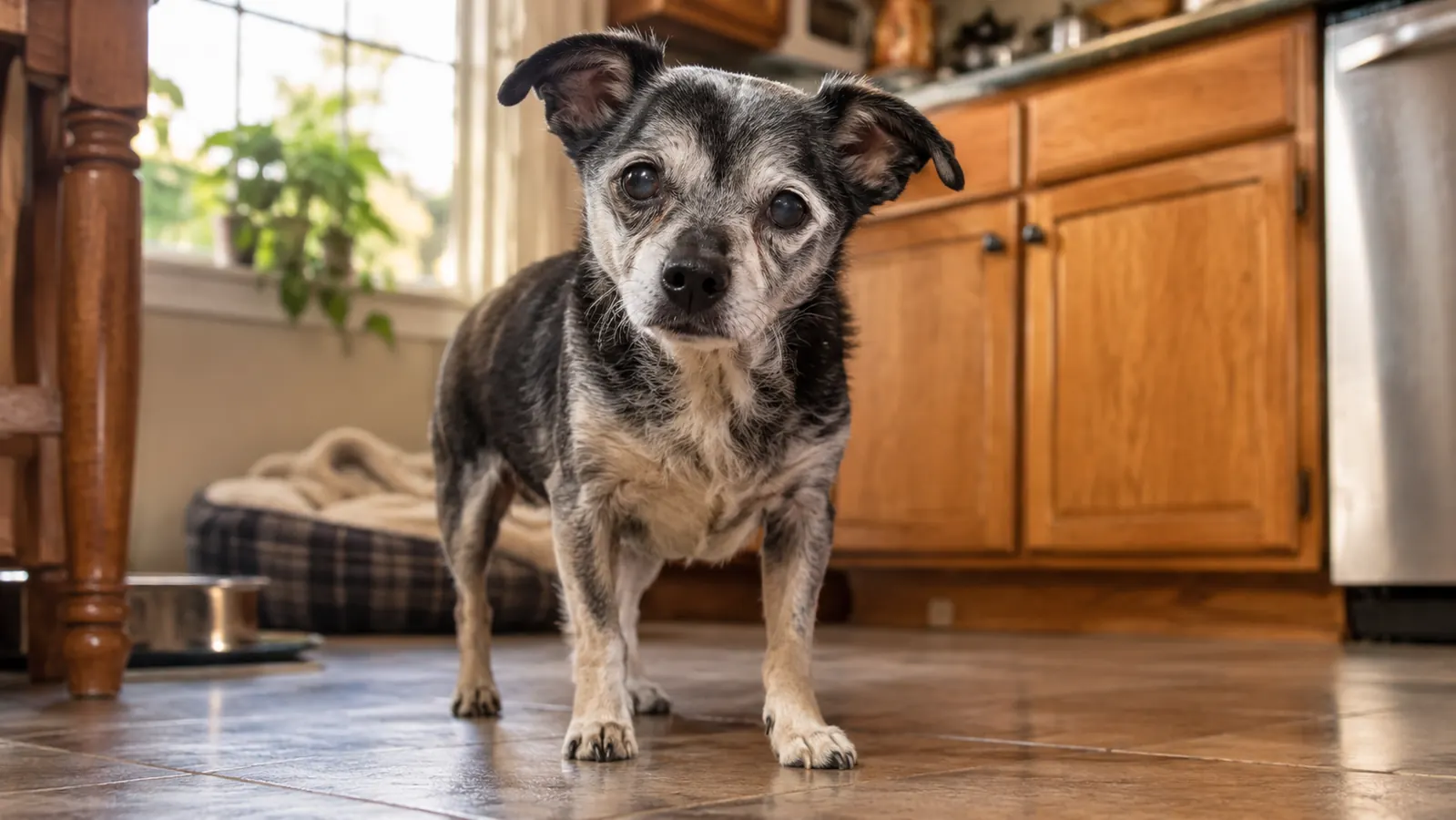
Pepper's back legs splayed out from under him on the kitchen tile in March. Not a fall, exactly. More of a slow spread, four paws pointing in four directions, ears down, waiting for me to do something about it. He is 13, a Yorkshire Terrier, about six pounds, and Dr. Salazar diagnosed mild arthritis in his hips plus a loose kneecap on the left back leg when he turned twelve. Tile has been the enemy ever since. I ordered DOK TigerToes grip socks that same week, mostly because theirs was the size chart I could actually read.
That was about eight months ago. Here is where I landed. The socks help, and they help in a narrow, specific way that is worth understanding before you order anything. They do not make an old dog young. They do not replace the Cosequin he takes every morning with breakfast, or the orthopedic bed on my side of the bedroom, or the foam stairs I bought for the sofa a month later. What they do is turn a slick floor into a floor he will walk across without bracing for it. That is a smaller claim than the listing makes. It is also the claim I can stand behind after a Tucson summer and most of an autumn. I am not a vet and this is not medical advice.
The Quick Verdict
A real fix for slick floors and a dog who braces before every step. Not a fix for the arthritis underneath, and the sizing takes a tape measure and some patience.
Amazon Check Today's Price →The tile stopped being a fight. That was the whole win.
Four socks, hook and loop straps, machine washable, sized down to a small paw. Measure across the widest part of the paw before you pick a size, because that number decides everything.
Amazon Check Today's Price on Amazon →How I've Used Them
The four socks live in a small basket by the front door, next to the leash and the bag of treats I keep for bribing him into things. Mornings, he wears them from after breakfast until about ten, which is when the house cools off and he moves to the rug anyway. Evenings, they go back on after his walk, when he follows me into the kitchen while I start dinner. That is the whole schedule. A few hours in the morning, a few hours at night, eight months running.
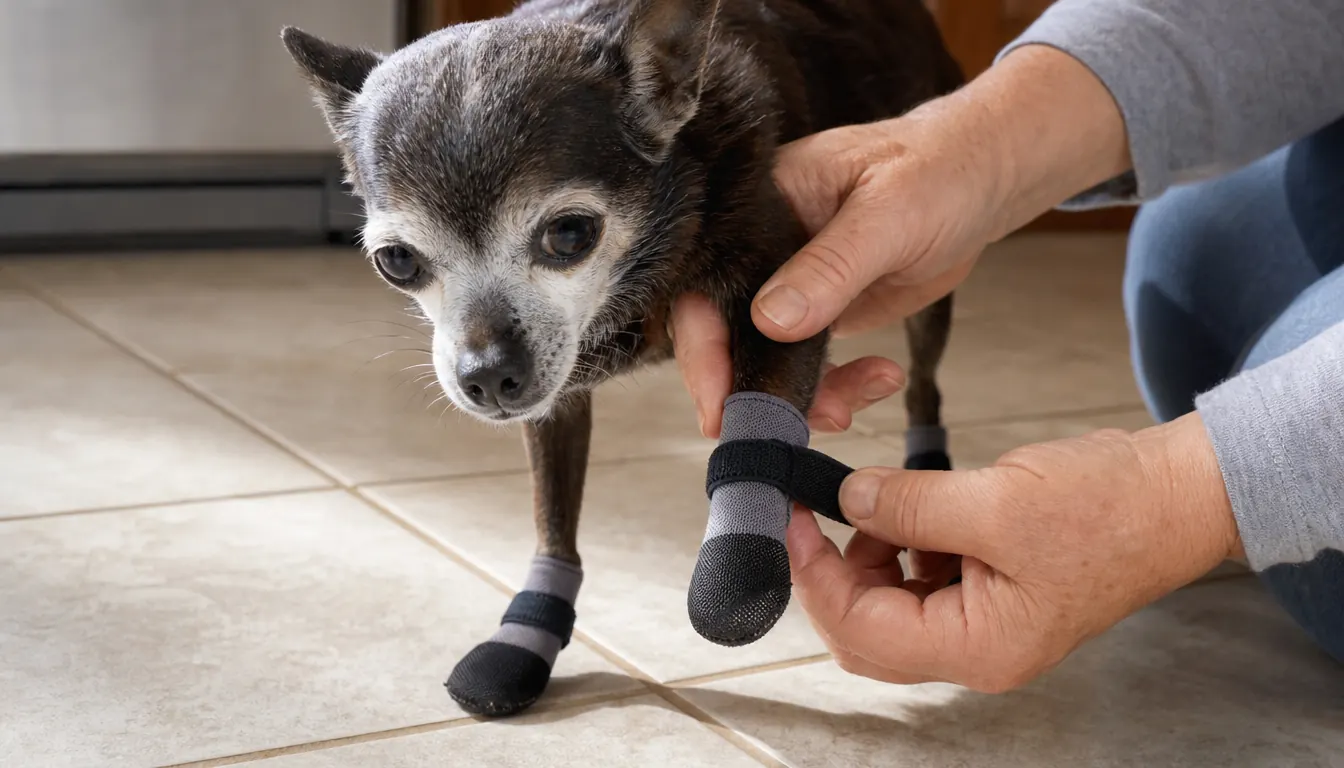
There is a small ritual to it. I sit on the kitchen floor with my back against the cabinet, put his front left paw in first because that is the worse knee, then the front right, then the two back ones. The back ones are harder, since he will sit down halfway through and I have to start over. Four socks takes me about a minute and a half in the morning now, closer to four minutes that first week. The strap gets pulled snug, then I run a finger under it to be sure it is not pinching.
They are not overnight socks. He sleeps in the orthopedic bed and I am not putting grips on a dog who is unconscious for eight hours straight. They are not outdoor socks either. Tucson sidewalks in summer will chew through anything, and the point of these is the floor inside my house. So they come off before the morning walk and they go back on after it.
The closure is a hook and loop strap, and the sock also pulls on over the paw, so there are two separate things holding it in place. That combination is the reason I stopped finding socks in the hallway. The strap sits above the paw rather than on it, which matters on an old dog whose skin is thin and whose ankles are bony.
What the Grip Actually Does on Tile
Our whole house is one story, tile throughout, with one area rug in the living room. I used to think of floors as neutral. They are not. A six pound dog with a loose kneecap has to make a small decision at every single step, and on tile that decision takes longer, and the longer it takes the more his back end drifts out from under him. The first morning he wore the socks he crossed the kitchen at something close to his old pace. I noticed that before I noticed anything else about the product.
Before I ordered anything I tried the cheap version of the fix. I bought a two foot runner rug and set it at the kitchen sink, because that was where he was sliding worst. It lasted four days. The rug slid on the tile when he stepped on the edge of it, and then he started walking around the rug instead of on it, which meant he crossed more tile than before. A towel on the floor did the same thing, bunched up under his front feet and made him stop dead. What I wanted was something that moved with him rather than something he had to stay on. That is the difference, and it is why I ended up looking at socks instead of more floor coverings.
The listing claims three times more grip and says it still works when the sock twists. I did not measure three times anything and I cannot tell you how they arrived at that number. What I can tell you is that the twisting claim held up. Pepper works his socks around when he walks, the way dogs do, and the traction was still there with the grip pointing sideways. The fabric is a stretchy cotton and nylon, thicker than a baby sock, and the sole has a texture you can feel with a thumbnail.
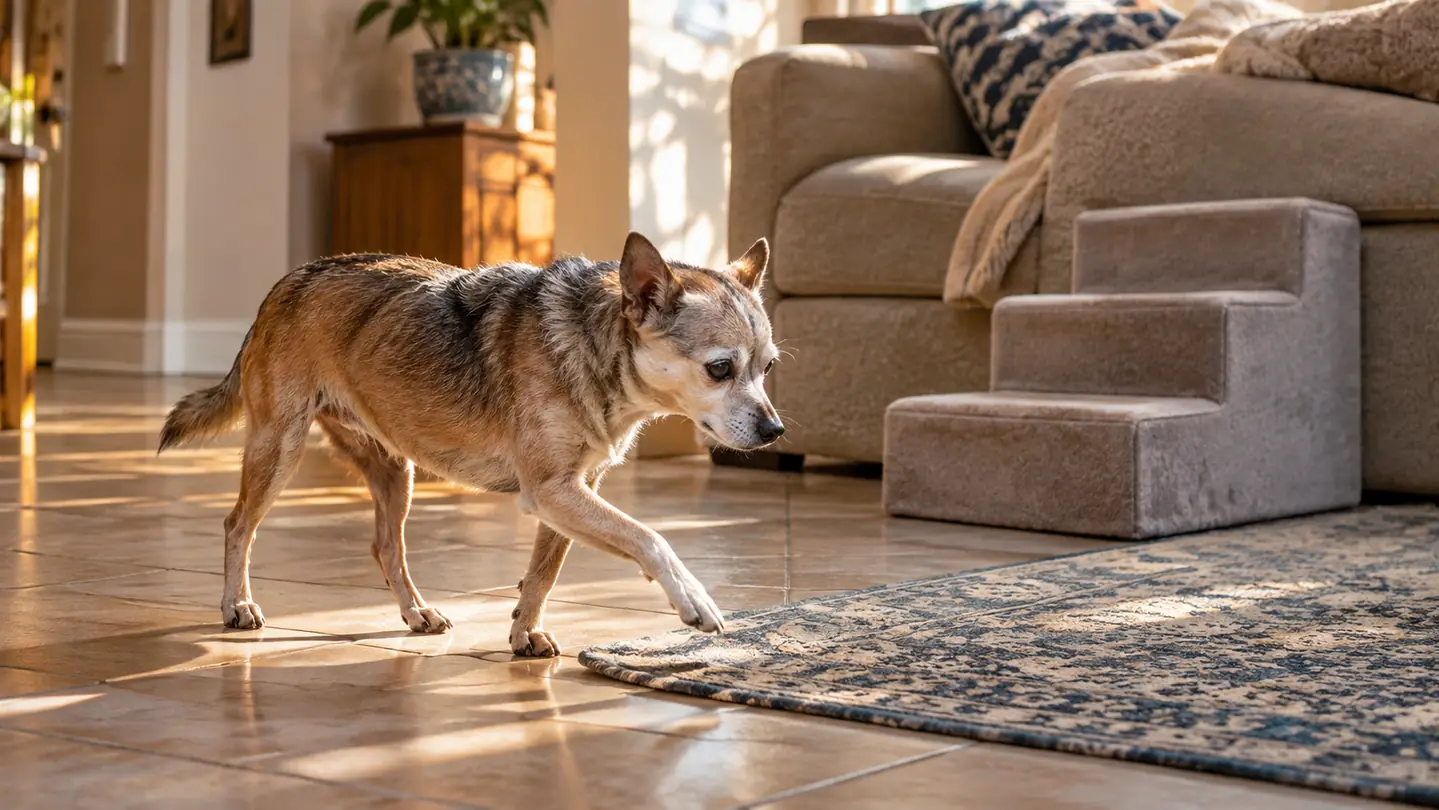
Where they stop is worth saying plainly. They do not help him get onto the sofa, because he does not jump anymore and a sock was never going to change that. They do not help on the one step down from the kitchen door to the patio, which is why the lift harness came along in June. They do not stop the arthritis and they do not tighten a loose kneecap. All they do is give his paws something to hold. Right after I mop, I still put a towel down and make him wait.
The socks did not make Pepper young again. They made the tile less of a fight, and that turned out to be worth a lot on a Tuesday morning.
The Sizing Was the Hard Part
The listing has a size dropdown and the sizes do not sit where you would guess they sit. The Small is listed for a paw width of 1.7 to 1.9 inches. I put Pepper's front paw on the kitchen counter with a ruler across the widest part, the way you would measure for a shoe, and it came in under that number. So I ordered the Extra Small, the smallest on the list. If you have a Yorkie or anything in that range, measure before you order. Guessing is how people end up writing reviews about socks that slide off.
Six pounds is a strange size for dog gear. A lot of products start at ten or fifteen and treat the bottom of the range as an afterthought. The DOK listing does at least go small, and the sock on the Extra Small fits him without bunching at the ankle. It was snug the first week. Not tight enough to leave a mark, but snug enough that I checked his ankles every time the socks came off, which I still do.
If your dog sits right on the line between two sizes, I would go up rather than down, because the strap gives you some adjustment and a sock that is too small will rub. That is my read after one dog and eight months, not a rule. Dr. Salazar's only comment when I showed her the socks was that the paw should look the same when they come off as it did when they went on. That has been my test ever since.
The First Two Weeks: High Stepping and One Escaped Sock
For about a week he high stepped around the living room like he was wading through shallow water. It is a little funny and a little sad and apparently completely normal. He would lift each front paw higher than it needed to go, set it down carefully, and then look at me. I did not make a production of it. I put them on, gave him a piece of chicken, and let him work it out on his own. By day seven the high stepping had mostly stopped. By day ten he was walking to his water bowl in them without thinking about it.
Day three is the one I remember. He walked out of the bedroom, across the tile hallway, into the kitchen, and stood at the back door waiting for me to let him out. That had not happened in weeks. He had been stopping on the rug at the edge of the living room and barking at me instead. I do not think the socks did anything magical that day. I think they gave him enough grip that the walk stopped costing him so much, and he decided the kitchen was worth the trip again. Small thing. It was the first time in a while I felt like I had fixed something.
We lost one sock, once. Not in the yard, not on a walk. It came off in the bedroom sometime during that first week, probably while he was turning around on the rug, and I found it under the bed two days later. The strap had loosened a notch. I tightened it and it has not happened since. If you have a dog who is a determined worrier of anything on his feet, the strap is the part to check before you leave the room.
He does not lick at them. He is not a paw licker generally, so I cannot tell you how they do with a dog who is. The listing mentions licking as one of the problems they are meant to help with, and I can see the logic, since a covered paw is a paw that is harder to get at. But I would be making that part up if I told you I tested it on him.
Washing, Straps, and the Daily Paw Check
The DOK socks go in the machine. I wash all four together in a mesh bag on a normal cycle and let them air dry on the counter, and after eight months of that they have kept their shape and their grip. The straps have not curled up. The seams have not opened. One sock has a slightly stretched cuff from being the one he wears on the back left, which is his worse leg and presumably the one that drags a little.
I wash them every Sunday whether they look dirty or not, so call it thirty-some washes by now. The mesh bag matters. A loose sock in a machine with towels will get its strap wrapped around something and stretched, which I learned in April when one strap came out longer than the other three and never quite went back. Since then the bag goes in with the load, not on the counter next to it.
The daily check is the part nobody puts on a listing. Every time the socks come off, I look at all four paws. Between the toes, around the ankle where the strap sits, and the top of the foot. Old dogs have thin skin and poor circulation, and a wrinkle in a sock can turn into a sore in a couple of days. In eight months we have had one small red spot at the strap line, and it cleared up after I gave him two days out of the socks.
That is the honest version of owning these. They are not a set it and forget it item. They are a small daily chore that buys you a dog who crosses the kitchen without bracing for the floor. For me the trade is worth it. For you it depends on how much you enjoy small chores and how much you mind the floor.
What I Liked
- Grip still holds on tile even when the sock rotates on the paw
- Extra Small fits a six pound dog without bunching at the ankle
- Hook and loop strap plus pull-on means it stays on through a normal morning
- Machine washable, eight months in and the sole texture is intact
- Thick enough that his paws are not sliding on cold tile first thing
Where It Falls Short
- Sizing is confusing, the Small is listed for a 1.7 to 1.9 inch paw
- Not built for overnight wear or outdoor walks
- The strap loosens and needs checking, we lost one sock that way
- Does nothing for the joint problem underneath the paw
Who This Is For
This is for the owner of a small senior dog who has watched their dog's legs slide out on a hard floor and does not want to carpet the whole house. It is for the dog who braces before every step, who takes the long way around the kitchen, who has quietly stopped following you into the room with the tile in it. It is also for the dog whose paws need protection from a floor that is too hot or too cold, and for the dog who licks at his paws until they are raw. If any of that sounds like your house, a set of grip socks is a small thing to try before you start rearranging furniture.
Who Should Skip It
Skip them if your dog will not tolerate anything on his feet and you are not willing to spend a week with chicken and patience. Skip them if you are hoping they will replace a vet visit, because a dog who is dragging a back leg or knuckling over needs Dr. Salazar, not a sock. Skip them if you have a big heavy dog, since the whole point here is a small paw and there are sturdier options for a retriever. And skip them if you want something you can put on in the morning and forget about, because the strap and the paw check are real work.
If your dog braces on the tile, start at the paws.
Measure across the widest part of the paw first. The rest is a week of chicken, a strap you check, and a look at all four feet every time the socks come off.
Amazon Check Today's Price on Amazon →