
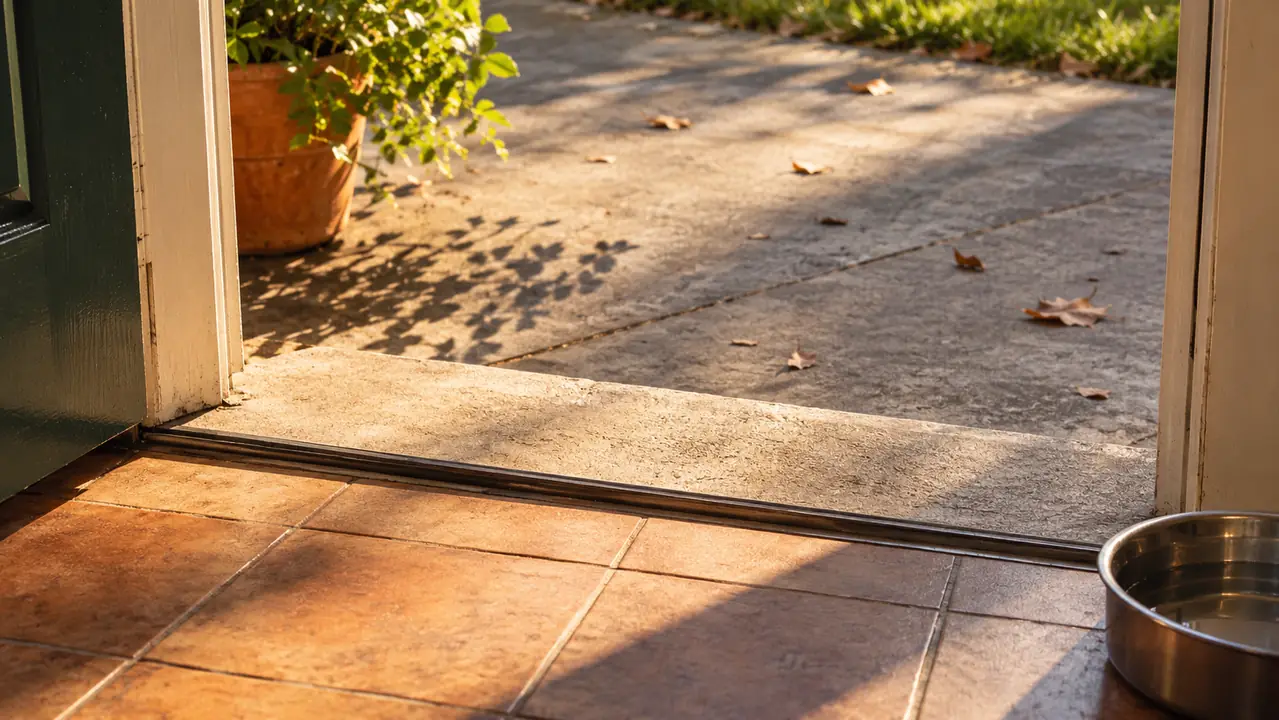
Pepper is thirteen, six pounds, and a Yorkshire Terrier, and last June he stumbled twice on the single step between the kitchen door and the back patio. That was the week I started comparing a rear support sling against the PICK FOR LIFE lift harness. I bought the harness. The short answer, the one I would give you standing in my kitchen: a rear support sling is a wide band that carries your dog's back end for you, and the PICK FOR LIFE lift harness is a sling you hold by a padded handle. Both do the same job for the same ten seconds of the day. They are built for different owners.
Here is what I actually own, because it changes how much weight to give the rest of this. The PICK FOR LIFE harness has been in my house since June, about five months. The rear support sling is one I read the listing on, checked the material and the sizing on, and decided against. I have never put one on a dog. So when I say a sling spreads support across the hips, I am telling you what the design is for, not what I measured in my living room. I am also not a vet. Dr. Salazar is. She diagnosed the arthritis in his hips and the loose kneecap in his left back leg when he was twelve, and everything below is my own experience sitting on top of her instructions.
Two things to hold in your head while you read the table. Both products lift only the back end, and neither one supports the front. And the left column comes straight off the PICK FOR LIFE listing, while the right column comes from the general shape of a rear support sling and from what those listings usually say.
| PICK FOR LIFE Lift Harness | A Rear Support Sling | |
|---|---|---|
| What it lifts | The back end only, from a sling under the hindquarters | The back end only, from a band under the belly and hips |
| Adjusting the fit | Drawstring closure, cinched almost all the way on a six pound dog | Usually a fixed loop or a single strap, so fit depends on the size you order |
| Handles | Padded handle, so the pull lands in your fist instead of your fingers | Usually a length of webbing you gather up |
| Spread of support | Lifts from a sling under the rear | A wide band spreads the load across the hips and belly |
| Getting it on a wiggly dog | Slide it under the rear and cinch the drawstring, which took my dog a few days to tolerate | One band under the belly, nothing to cinch |
| Care | Nylon, machine wash | Varies by brand, and many ask for hand wash or spot clean |
| In the box | Sling, handle, storage bag, user guide | Usually the sling alone |
| Warranty | Seven days from the listing, which is short | Often nothing stated |
| Best for | A small dog who needs steadying on a step or on a bad morning | A dog who needs continuous rear support for longer stretches |
That is the argument in nine lines. The rest of this is the part that made the difference in my house.
Where PICK FOR LIFE Wins
The drawstring is the reason I could use this at all. Size Small is the smallest size on the listing, and it is still roomy on a six pound dog with very little underneath him. The drawstring closure lets me cinch it almost all the way, so the sling sits up against his rear instead of hanging loose. A fixed loop in the same nominal size would have been a sack. If you have a toy breed, that adjustability is the whole ballgame, and it is the first thing I would check on any sling you are considering.
The padded handle is the second thing. My hands are sixty three years old and my grip is not what it was at forty. The difference between a padded handle and a bare strap is the difference between doing this twice a week and quietly giving up on it by February. The whole thing weighs 4.8 ounces, so on the mornings I do not need it, it goes in the storage bag in the car and I forget it is there until I need it again.
Third, it goes in the machine. Nylon, machine wash, and I have washed it more than once after a wet morning. It comes out the same sling it went in, which is not something I can say for every piece of dog gear in this house.
One more thing that is not on the label. Once the drawstring is cinched, the sling holds its shape against him, so I can let go with one hand to open the patio door and the whole thing stays put. With a loose band I would be re-seating it with the same hand I need for the door handle. Small thing. It is the small things that decide whether you keep using a tool or leave it on a hook.
Where a Rear Support Sling Wins
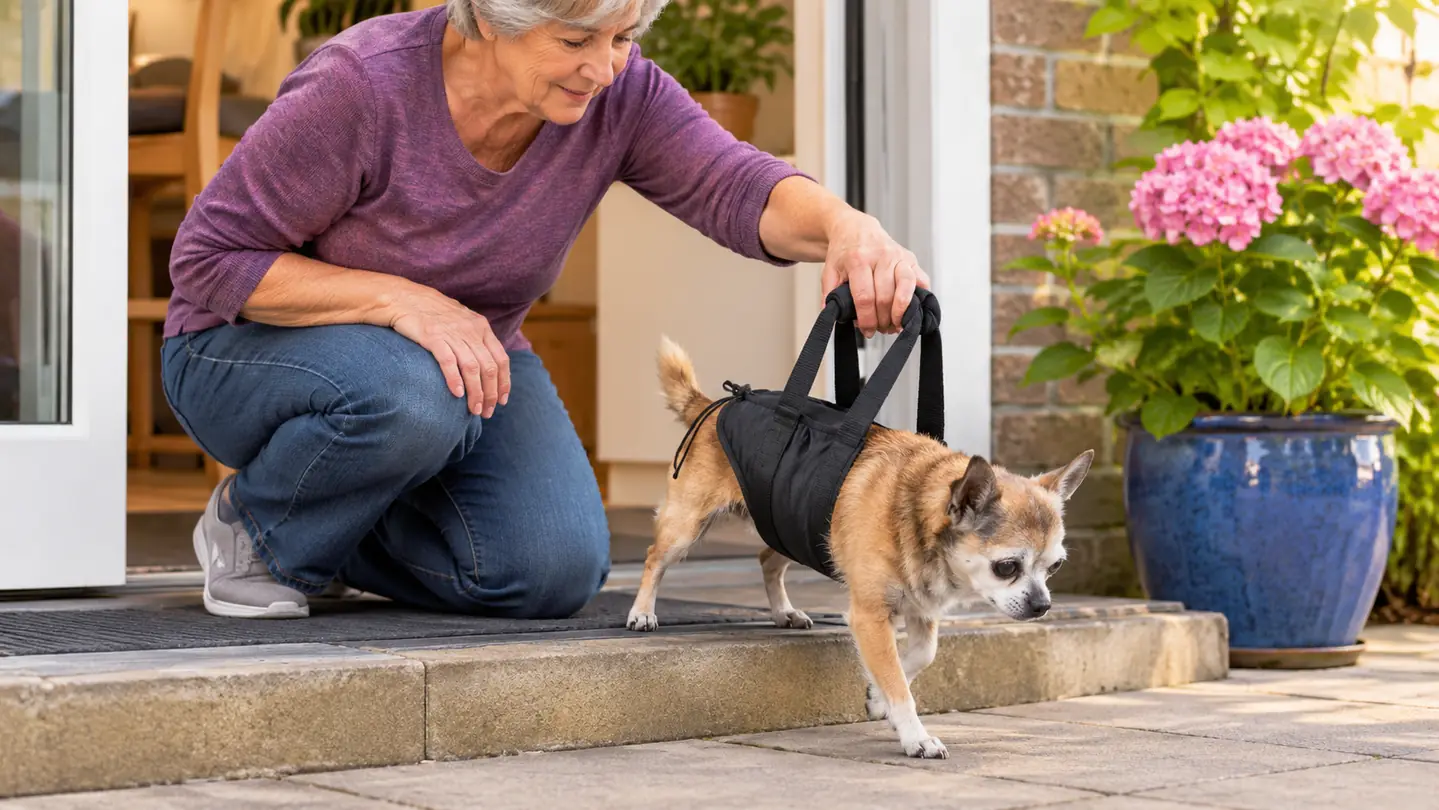
The sling wins on spread. If your dog needs his whole rear cradled rather than just lifted, a wide band under the belly and hips puts the support over more surface area, and that is gentler on hips that are sore to the touch. The PICK FOR LIFE harness lifts from a sling under the hindquarters. That is exactly right for a step. It is slightly less than right for a dog who has to be carried twenty feet across a parking lot.
It also wins on getting it on. There is no drawstring to fuss with. You slide the band under the belly, gather the ends, and lift. For a dog who panics at handling, or an owner whose hands do not cooperate before coffee, fewer steps is a real advantage. My dog stood still for the drawstring after a few days, but those few days were not fun for either of us and I am not going to pretend otherwise. A sling with fewer parts to negotiate would have been the easier thing to teach.
There is also the question of what your dog will accept. Some dogs hate a band around the middle and will freeze solid. Mine froze for a drawstring but not for something under his rear, which tells you that neither design is universally tolerated. You know your dog better than any listing does, including this one.
And there is less to keep track of. A sling is one piece. The harness comes with a handle, a storage bag and a user guide, which is thoughtful on a hook by the door and one more thing to lose on a kitchen counter.
The harness that got my six pound dog down the step
Size Small with a drawstring closure that cinches down to a toy breed, a padded handle, nylon, machine washable, 4.8 ounces with a storage bag included. Check the size chart and today's price on the listing before you order.
Amazon Check Today's Price on Amazon →What Five Months of Twice-a-Week Use Looks Like
I want to be honest about frequency, because a page that says every single day would be lying about my house. The harness comes out about twice a week. It comes out on the bad mornings, the ones after a long nap when the kitchen step looks like a wall, and it comes out on a walk when his back legs are not keeping up with his front ones. The rest of the time he takes the step slowly on his own and I stand behind him with my hands out like a goalie.
The first days were a negotiation. He did not care for anything going under his rear, and he said so by sitting down every time I got it into position. I went back to treats and did it for a few seconds at a time, no lifting, just on and off and a piece of chicken. By the fourth day he stood still. Now when I pick it up he walks over to the step and waits, which is either cooperation or a strongly held opinion about chicken.
There was a Tuesday in August I still think about. He came out of a nap stiff enough that his back legs crossed when he stood up, and I honestly thought that was the morning we stopped doing the patio. I put the harness on him, held the handle, and he took the step. Then he walked to the water bowl. Nothing heroic. But a year earlier, a morning like that would have ended with him lying back down and me carrying him outside for the rest of the week.
On the step itself it is one motion. Cinch the drawstring, hand into the padded handle, take some of his weight while he steps down. I am not carrying him. That distinction matters to me, because carrying a dog who still wants to walk is how you end up with a dog who stops trying.
I also use it instead of scooping him under the belly, which he has always hated. Dr. Salazar pointed out that scooping a stiff dog up under the middle puts pressure right where it hurts, and she was right. Lifting from above and behind is something he tolerates and something my back tolerates, which is not nothing at my age.
The Details on the Listing, Including the One I Do Not Love
The listing is specific enough to be useful. Size Small, small dog recommendation, nylon, drawstring closure, machine wash, 4.8 ounces, package dimensions of 5.28 by 3.62 by 3.54 inches. In the box you get the sling, a handle, a storage bag and a user guide. When I looked, it carried 4.4 stars across more than six thousand ratings, which is the reason it was on my screen in the first place.
The part I do not love is the warranty. Seven days. That is a return window more than a warranty, and I would rather tell you that than let you find it yourself. Mine has held up fine through five months of light use, but if you plan to use one twice a day on a dog who pulls, understand that after the first week you are on your own.
It is not a wheelchair and it is not a cure. It is ten seconds of help on the days he needs it, and ten seconds is the difference between him taking the step and him refusing the patio for a week.
Neither One Is a Fix
Pepper still has arthritis in his hips and a loose kneecap in his left back leg. He still does not jump onto the sofa or the bed. He still has slow days, and on a slow day no piece of nylon in my hall closet changes that. The harness did not stop his arthritis and I would not trust a page that told me it could.
What it did is narrower and more useful. It removed one small daily obstacle so that he keeps using his legs instead of being carried over it. That, plus the Cosequin he has taken since the diagnosis, plus the grip socks on the tile, plus the foam stairs at the sofa, is the whole of what we do. None of it is dramatic. All of it together is why a thirteen year old dog still walks to the end of the block in the morning, slowly, with his nose down.
Who Should Buy Which
Buy the PICK FOR LIFE lift harness if you have a small dog who still walks but needs his back end steadied on a step, a threshold or a bad morning, and if you want the pull to land in your hand instead of your fingers. Buy it especially if your dog sits at the very small end of the size chart, because the drawstring is what makes a roomy Small work on a six pound frame.
Look harder at a rear support sling if your dog needs to be carried for real distances, if his hips are too sore for a narrow sling under the hindquarters, or if he will not stand still for a drawstring. A sling is also the more sensible first purchase if you are not sure you will keep up with the routine, because there is less to learn and less to lose.
And if you are not sure either one is the right tool, have your vet watch your dog walk and take the step. Dr. Salazar watched Pepper cross her exam room twice and told me which end of him needed help. That five minutes saved me from buying the wrong thing, which is worth more than any table on any page, including mine.
One step, one handle, and a dog who still walks to the end of the block
The PICK FOR LIFE lift harness in size Small. Drawstring closure, padded handle, nylon, machine washable, 4.8 ounces, storage bag included, small dog recommendation. Check the current price and the size chart on the listing before you order.
Amazon Check Today's Price on Amazon →