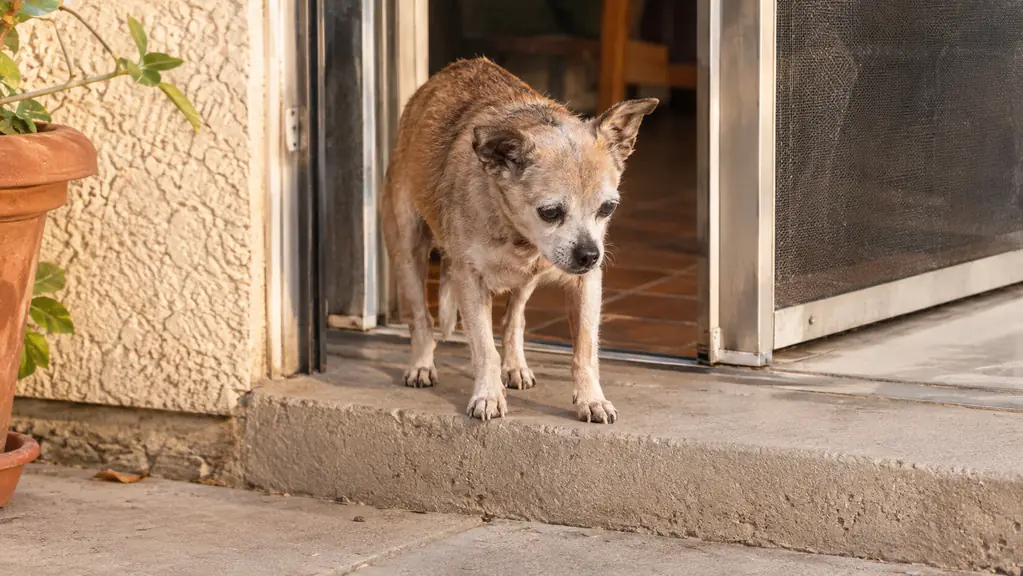
There is one step in my house and I have come to hate it. It sits between the kitchen door and the back patio, maybe six inches of concrete, and for the first twelve years of Pepper's life he went over it at a trot without breaking stride. He is a thirteen year old Yorkshire Terrier, about six pounds, and last spring he started stopping at the top of it. Not falling. Stopping. He would look down at the patio, look back at me, and wait. That wait is the whole story.
I tried the things you try first. I scooped him under the belly, which he tolerated for about two weeks and then started leaning away from. I tried letting him figure it out, which mostly meant watching him hesitate for a minute and then take it in one stiff legged drop that made me wince. What finally worked was a rear end sling, the PICK FOR LIFE lift harness in size Small, which I bought in June after a bad week of stiffness. It is not a cure for anything. It is a handle. That distinction turns out to matter more than anything else in this article.
One handle, one step, one less thing to wince at
The rear support sling that lifts the hindquarters only, with padded handles and a drawstring closure, for a small dog whose back legs need a little help and whose front legs are still doing their job.
Amazon Check Today's Price on Amazon →The Five Steps, in the Order I Would Do Them Again
Step 1: Find out which end of your dog needs help before you buy anything
Before I bought a thing I took Pepper to Dr. Salazar, who has been his vet since he was a puppy. She had already diagnosed mild arthritis in his hips and a loose kneecap on his left back leg the year before, when he was twelve. What I wanted from that visit was narrower than a diagnosis. I wanted to know which end of him was failing. A wobbly dog can be wobbly in the front, in the back, or everywhere, and those are three different problems with three different answers.
For Pepper it was the back. His front legs are still strong. He pulls on the leash with them and pushes himself up off the rug with them. His back legs are the ones that splay on the tile and hesitate at the step. That one sentence decided everything that came after, because a rear support sling only does one job. The PICK FOR LIFE harness is built that way on purpose. It goes under the belly and lifts the hindquarters, and it does nothing at all for a dog whose front end is the problem.
I am not a vet and I am not going to pretend to be one on your behalf. If your dog has started wobbling, get him looked at before you spend money on nylon. Ask the question out loud: which end needs help, and is this a harness situation, or a ramp, or a sling, or a change in the medication. Write the answer down, because the pet store is a confusing place and the Internet is worse.
Step 2: Measure him and size down, then let the drawstring do the rest
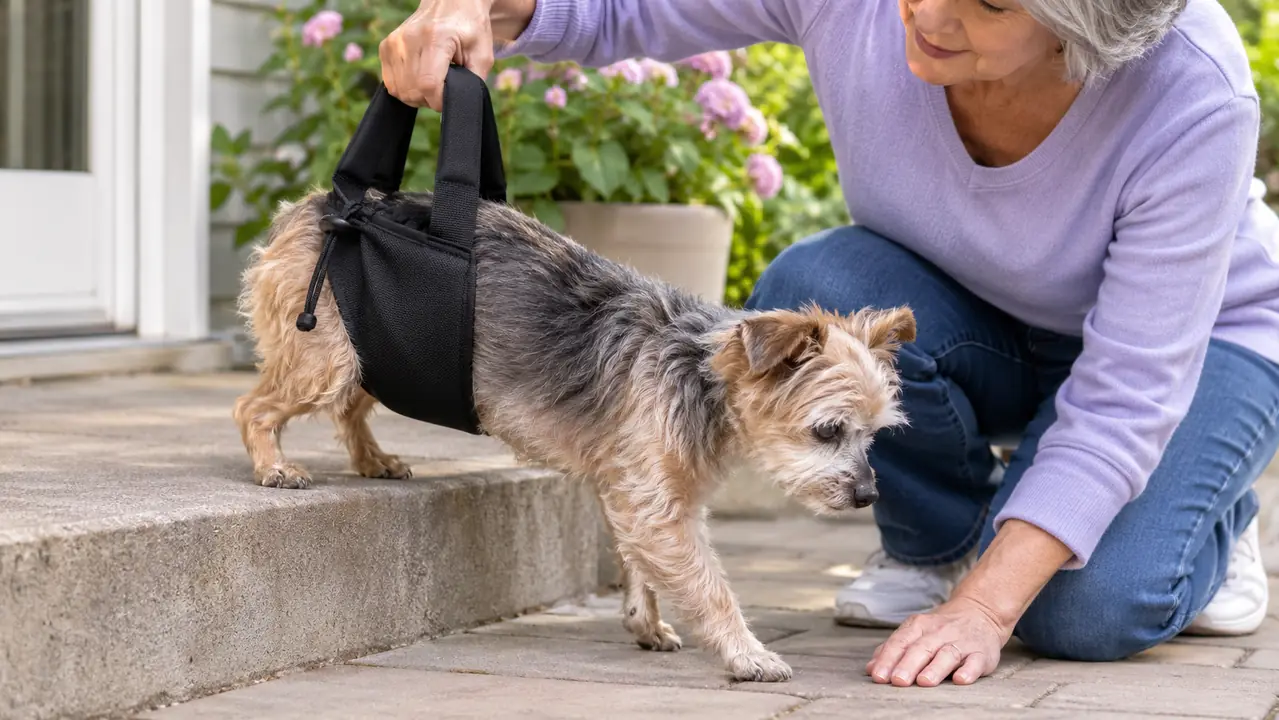
Pepper weighs about six pounds. The PICK FOR LIFE listing has a size dropdown, and Small is the smallest size on it, so that is what I ordered. Even at the smallest size the sling is roomy on him. The closure is a drawstring and I have it cinched almost all the way in, which is what makes it sit snug instead of sliding around while I am taking his weight.
When the package arrived I laid the sling flat on the kitchen counter next to a tape measure before I put it anywhere near the dog. The box itself measured 5.28 by 3.62 by 3.54 inches and weighed under five ounces, which tells you how little there is to this thing. What I wanted to know was how much of the sling was strap and how much was the part that actually goes under him, because a sling with too much fabric bunches up between the back legs and a sling with too little cuts in. On Pepper, cinched down, the fabric sits under the hindquarters and stops well short of anything it should not touch.
If your dog lands between two sizes, size down and use the drawstring rather than sizing up and hoping. A sling that shifts mid lift is worse than no sling, because it puts the pressure in the wrong place and the dog learns to hate the sight of it before you have helped him once.
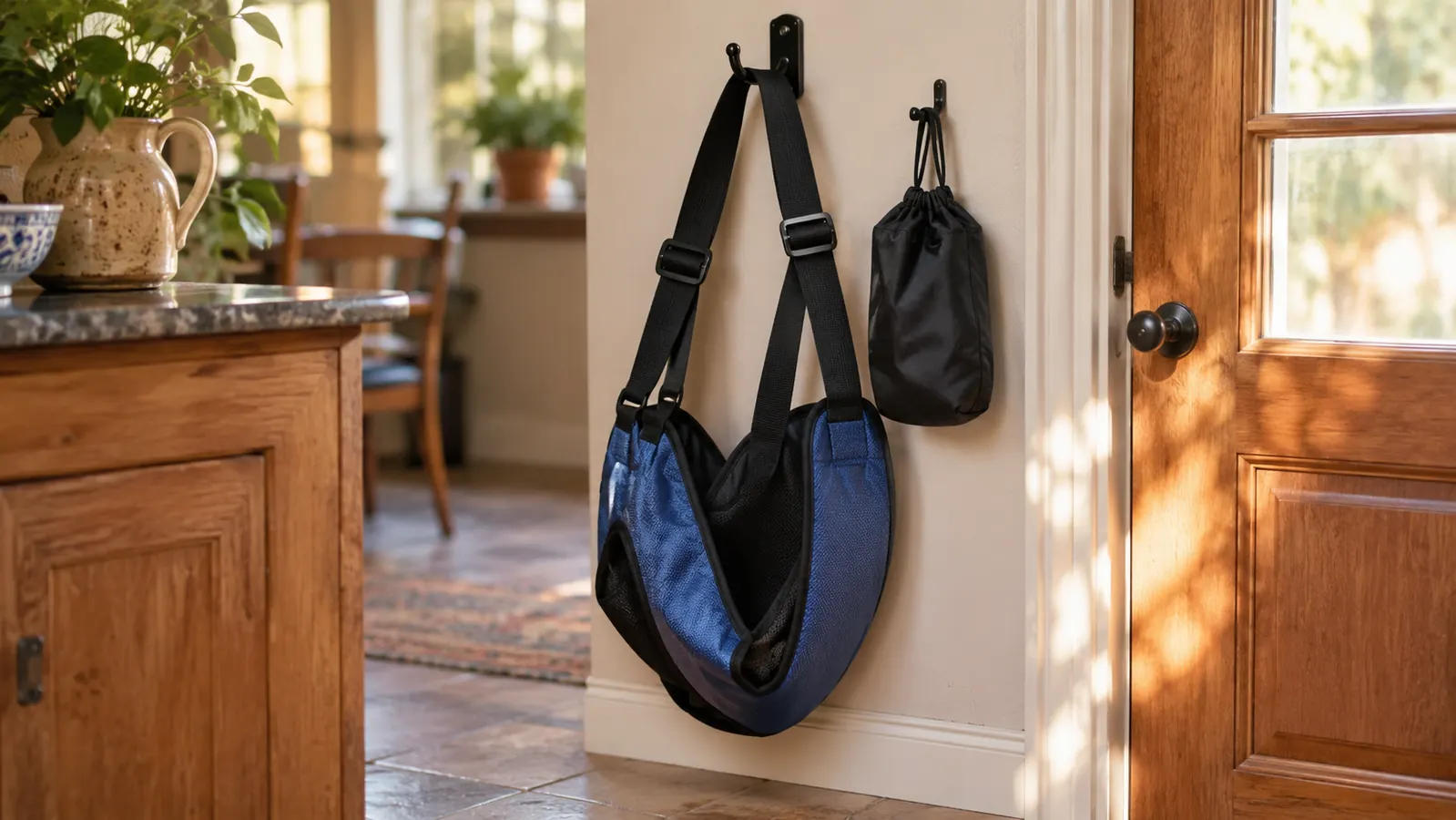
The whole thing weighs under five ounces, which matters a great deal on a six pound dog. The material is nylon, the handles are padded, and it is machine washable. Mine gets rinsed and hung over the laundry sink more often than it gets a full wash, but it has been through the machine twice and came out fine. It also ships with a storage bag and a user guide. The bag now lives on a hook by the back door, which is the only reason I remember to reach for it.
Step 3: Put it on and take it off for three days with no lifting at all
The first three days I did not lift him. I put the sling on him in the living room, gave him a small treat, and took it off again. Twice a day. That was the entire program.
This sounds like nothing. It is not nothing. A thirteen year old dog has opinions about straps appearing under his belly, and Pepper's opinion was to walk away and lie down on the rug with his back to me. It took a few days before he stood still for it. What got him there was the treat and the fact that the sling always came off again within a minute, so it never became a thing that happened to him, only a thing that visited.
By the fourth day he was standing still for it without the treat in my hand, which I took as permission to try something harder. I put it on him on the flat kitchen tile with the door closed and walked him four steps forward and four steps back across the floor, lifting nothing, just letting the handle rest in my palm. He did that twice before he stopped and looked at the door, which in his language means he was done. Fine. Three days of that, and I did not touch the step until he was bored with the sling.
If your dog is more tolerant than mine you can skip ahead. If your dog is less tolerant, give it a week. Nothing in this process moves faster than the dog wants it to move, and rushing the introduction is how people end up with a perfectly good sling in a drawer.
I am not holding him up. I am holding up about a third of him and letting the other two thirds do the work they can still do.
Step 4: Learn to take weight, not to carry him
Here is the part I got wrong for two weeks. I was lifting him. Not helping him, lifting him, taking his back end off the ground and carrying him over the step like a suitcase with ears. He hated it and I did not blame him.
The right amount is much less than you think. You take the handle, you stand beside him rather than behind him, and you take maybe a third of his weight so his own feet can find the ground and do the rest. His back legs still have to work. The sling is there to catch the moment when they don't, not to replace them.
The first real attempt, I took too much. I had the handle in my hand, I felt his weight come off the concrete, and before I thought about it I had his back feet hanging in the air about an inch off the ground. He scrambled, I set him down, and we both stood on the patio looking at each other. What I do now is simple: I let him start the step on his own, I take the handle only when I feel him hesitate, and I follow his weight rather than lifting it. If my forearm is tight at the bottom of the step, I took too much.
Two things to keep straight. The harness supports the rear only, so it is not a carrying strap, and I would not use it to move him. Pepper still gets picked up for the car with one hand under the chest and one under the rear, exactly as before. The other thing is the landing. The paw that comes down off the step should land flat and not on the edge, which means you walk at his pace and not the pace you would like to be walking.
Step 5: Use it on the step, not on the whole walk
We use it about twice a week, and almost always on the same six inches of concrete. Bad mornings get the sling at the kitchen door. Good mornings he takes the step on his own, slowly, one back leg and then the other, while I stand there with my hands at my sides like a woman watching somebody parallel park.
On a bad morning on the walk around the block, the sling comes along too, and I use it for the first few minutes until he loosens up and then I carry it in my hand for the rest. He is not walking in it for fifteen minutes. Nobody wants that, him least of all.
The temptation, once you have a handle, is to use it for everything. I would push back on that for a dog with arthritis and a loose kneecap. Dr. Salazar's instruction was gentle daily movement, and the movement is the medicine. A sling that takes over the entire walk takes away the thing that is still keeping his legs under him. The PICK FOR LIFE harness earns its place in my house precisely because I do not use it every day.
What Else Helps
The sling solves one problem, and that problem is the step. It did nothing for the tile, the sofa, or the eight hours he spends asleep. For those I use other things, and I would rather tell you what each one is actually for than pretend a single piece of nylon fixed an old dog.
The tile floors came next. Pepper's back legs splayed on the kitchen tile one morning in March and that was the end of bare feet in this house. He wears grip socks indoors for a few hours in the morning and again in the evening, never overnight and never on a walk. I check his paws every day when the socks come off. We have one area rug in the living room and he knows exactly where it is, which tells you something about how carefully an old dog maps a floor when his footing stops being free.
The sofa got a set of three foam stairs on that rug, after he misjudged a jump and yelped. The human bed is too tall for those stairs, so he does not sleep on the human bed anymore. He sleeps on an orthopedic bed on the floor on my side of the room, and it took him three nights to give up the old fleece pad. He also takes one joint chew every morning with breakfast, the amount Dr. Salazar set for his size, and you should follow the label and your own vet on that rather than copy me. Twelve months in, the chews have made his mornings easier. They did not fix the kneecap and they did not bring back jumping, and neither did anything else in this house.
The piece of equipment I reach for twice a week, not every day
The PICK FOR LIFE sling gives rear end support with padded handles, a drawstring closure that snugs down on a small dog, and machine washable nylon. It will not fix the arthritis. It will get him down the step without the wince.
Amazon Check Today's Price on Amazon →