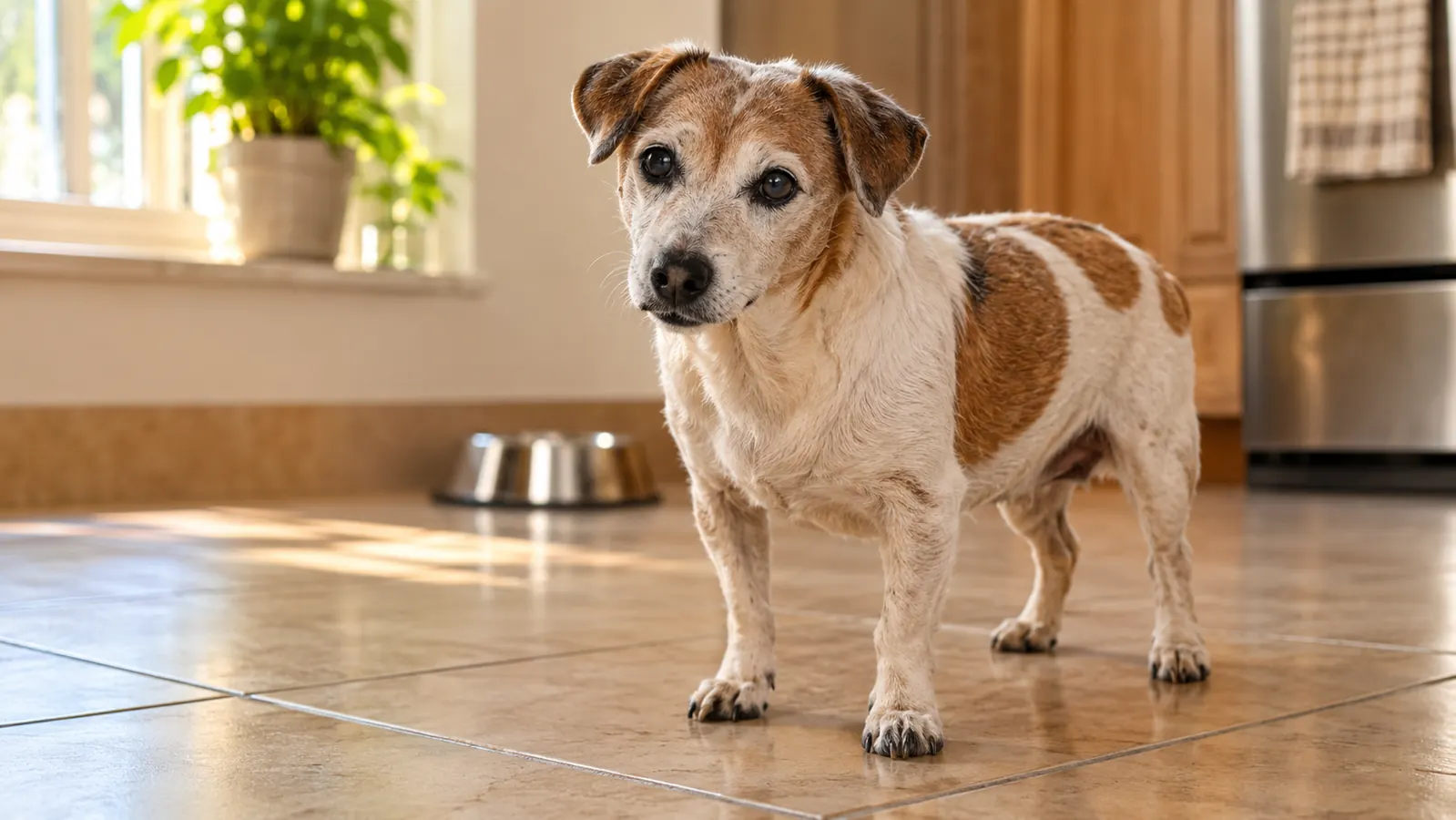
Pepper's back legs slid out from under him on the kitchen tile in March. Not a fall, exactly. More of a slow splay, all four feet drifting outward at once until he sat down hard and looked up at me as though I had arranged it. He is a 13-year-old Yorkshire Terrier, about six pounds, with a loose kneecap in his left back leg that Dr. Salazar found the year before. Tile runs through this entire house. There is one area rug in the living room and nothing else.
For a while I thought the answer was a rug in every room. Then I thought about what that would cost, looked at my husband Ray's face, and dropped it. I tried trimming the fur between Pepper's pads. I tried a folded towel by the water bowl, which he ignored. I tried carrying him from room to room until my own back started complaining louder than he does. What actually worked was unglamorous: a set of DOK TigerToes grip socks for the tile, a foam stair set for the sofa, and a routine I can keep up on an ordinary Tuesday. This is the sock part, step by step, written the way I wish somebody had written it for me in March.
The tile stops being a hazard the day the socks go on
Pepper wears his DOK TigerToes for a few hours in the morning and a few in the evening. That is the entire change. Four socks per set, a hook and loop strap on each one, and a size chart worth reading twice before you order.
Amazon Check Today's Price on Amazon →The Five Steps That Stopped the Sliding
Step 1: Measure the Paw Instead of Guessing the Size
The listing has a size dropdown, which is the first thing to look at and the first thing most people skim past. The Small is built for a paw that measures 1.7 to 1.9 inches across. That sounds tiny until you put a tape measure on a small dog and find his back paw sits under it. Pepper's paws measured narrower than that, so I ordered the Extra Small. The set comes with four socks, which matters later when one pair is in the wash.
Here is how to measure without guessing. Put a sheet of paper on the hard floor and let him stand on it with his full weight, because a paw spreads when it bears weight and pulls in when you lift the leg. Mark the widest point across the pads. Do the front paws and the back paws separately, since they are not the same width on most small dogs, and measure the marks with a ruler. Repeat it on three different days. A stiff dog stands differently after a nap, and one measurement taken at the wrong moment will lie to you.
Getting this wrong is the most common way grip socks fail. A sock with room to spare will twist and work its way off by mid morning, and the strap will not save it. A sock that is too snug rubs the same spot on the same toe every single day. The material is a stretchy cotton and nylon blend, so it forgives a little, but it will not forgive a whole size. If your dog lands between two sizes, go with the smaller one and check the strap line after the first wearing.
Step 2: Put Them On Sitting on the Floor, Not Standing Over Him
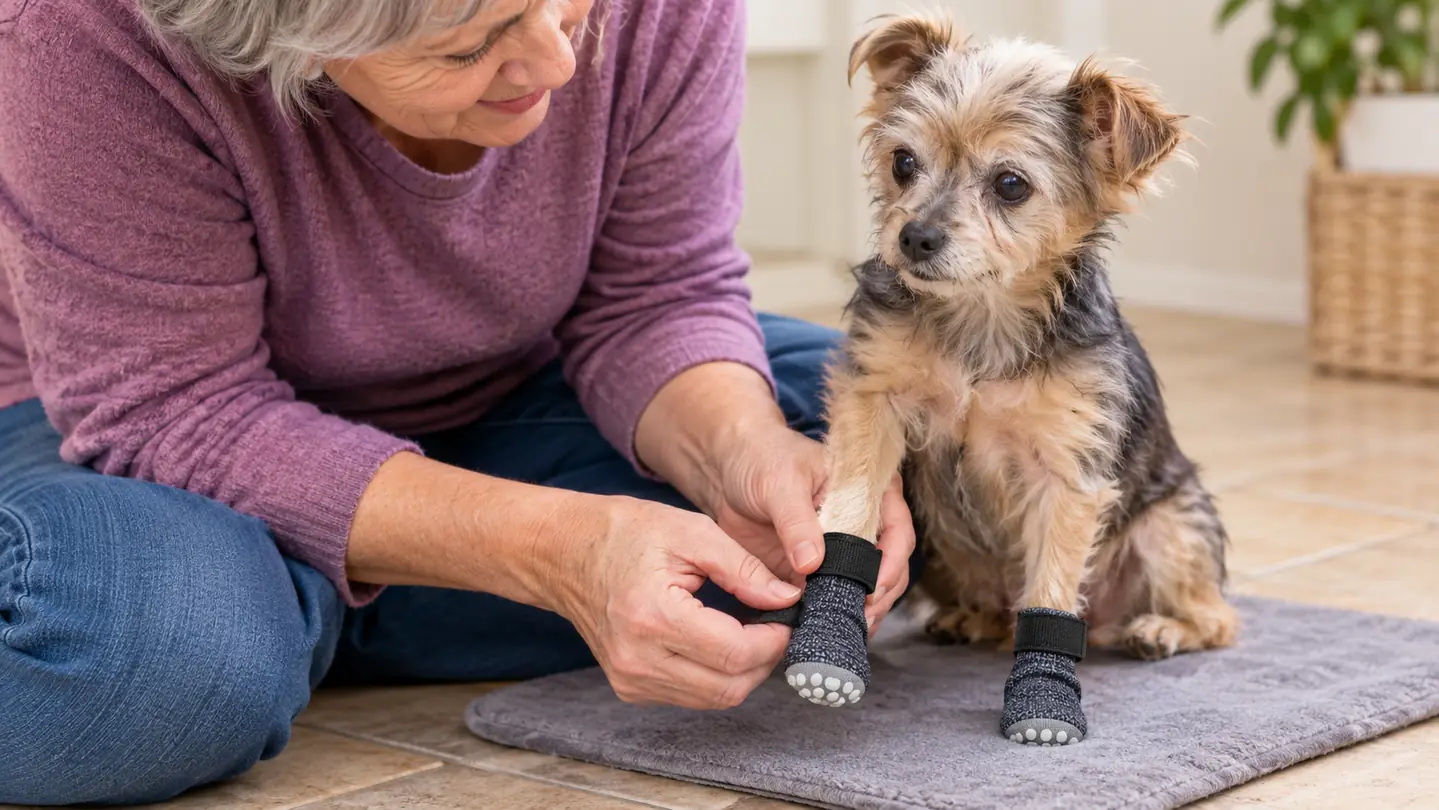
Sit down on the floor with your back against a cabinet and put the dog in your lap or between your knees. This sounds like a small thing. It is not. Standing over a small dog and reaching down makes him brace and back away, and then you are chasing six pounds of opinion around a kitchen with a sock in your hand. At floor level he is calmer and you have both hands free, which is the only way this goes quickly.
Open the hook and loop strap before you start, and roll the cuff back so the opening is as wide as it will go. Slide the sock over the paw one toe at a time rather than pulling it on in one motion. Ease it past the knuckles, which is the part that resists, then settle the cuff above the wrist and press the strap down flat. Smooth the fabric so nothing is bunched under the pad. A bunched seam feels like a pebble underfoot and he will walk on three legs to tell you so.
The first day, do one sock. That is all. Pepper got one on his front left, a piece of chicken, and a lot of quiet praise, and then we were done. The next morning we did two. By the end of that week he was wearing all four without any drama. If you try to put four socks on four strange feet on day one, you will both hate the whole project by Thursday.
Step 3: Snug the Strap, Then Check It Twenty Minutes Later
The strap is what keeps the sock on, and there is a narrow range between snug and too tight. Fasten it so it sits flat against the leg with no gap and no pinch, then slide one finger underneath. If your finger goes in easily and comes out easily, that is about right for a dog this size. If the strap leaves a groove in the fur, it is too tight, and the fix is a smaller sock rather than cranking the strap down further.
Check the fit twenty minutes after you put them on, not at the end of the day. Look at the strap line on each leg and at the skin between the toes. Pink and slightly indented is fine. Angry red, a raw patch, or a swollen toe means take them off and rethink the size. Pepper's first pair rubbed a little on the right back leg until I loosened that one strap a notch, and after that it never happened again.
If a strap keeps coming undone, that is usually a sizing problem wearing a disguise. On a narrow leg the strap has more distance to cover and the sock shifts underneath it. Fur makes it worse. Trimming the hair right where the strap sits, without taking it down to the skin, gives the hook and loop something to hold and stops the sock from rotating around the leg.
Step 4: Let Him High Step for About a Week
For the first week he will walk like he is crossing a shallow creek. High steps, one foot lifted and held, a small pause before each one. This is normal. He is getting used to a surface that grips instead of slides, and his brain has not decided yet whether it likes the change. Pepper did this for about seven days and then stopped noticing them entirely.
Do not take them off at the first funny walk. That is the mistake I nearly made. Put the DOK TigerToes on right before something good happens, dinner or a chew or his spot on the sofa, so the socks stop being the event and the good thing becomes the event. Sit on the floor with him for the first few minutes if he plants his feet and refuses to move. He will follow you eventually, and the high stepping fades on its own.
These are indoor socks. Pepper wears his for a few hours in the morning and a few hours in the evening, never overnight and never on a walk. Outside, the grip picks up grit and wears down on pavement, and a wet sock on a small foot is worse than no sock at all. If his feet get damp, take the socks off and let everything dry before they go back on.
Step 5: Check His Paws Every Day and Wash the Socks
Take them off at the same time every day and look at his paws while you do it. Between the toes, the strap line, the nails, the pad itself. It takes fifteen seconds and it catches small problems before they turn into a vet visit. Pepper's paws get checked every morning when the socks come off, and in eight months the only thing I have found is one small callus that was there before the socks were.
The DOK TigerToes are machine washable, and they need it. I wash his about once a week with the regular laundry, in a mesh bag so they do not vanish into the drum, and let them air dry. Four socks in the set means one pair is on the dog and one pair is clean, so you are not running an emergency load the night before a vet appointment. Skip the dryer. The elastic will thank you.
The last step is the least satisfying one, which is that you have to do it most days. A few hours in the morning on the tile, a few in the evening, then off for sleeping. Some days I forget. On the days I forget, he slides again by mid afternoon, and I am reminded why ten minutes of hassle is worth it.
What Else Helps
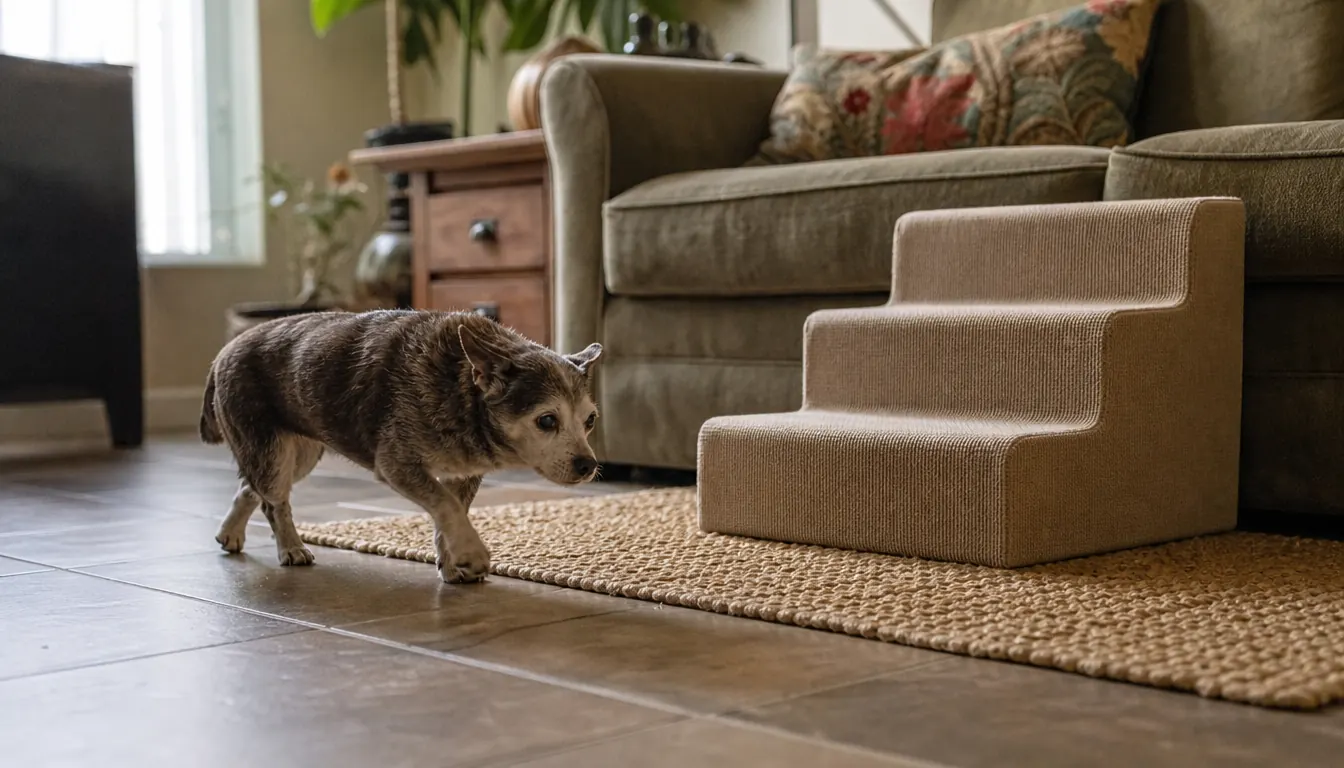
Socks fix the tile. They do not fix the sofa. Pepper misjudged a jump at the sofa in April and yelped, and that is what sent me looking at foam stairs. The set we have is beige, three steps, and it sits on the living room area rug pushed against the sofa so it cannot slide, which is the only reason it works. A stair set on bare tile is just a different way to fall.
The one step down from the kitchen door to the back patio gets a lift harness on bad mornings, about twice a week, not every day. I use it instead of scooping him under the belly, which he has made clear he dislikes. It holds up his back end and lets him do the work with his front. On good days he takes that step slowly on his own and I let him, because doing it himself is worth something to him.
Sleep is its own thing. His bed sits on my side of the bedroom, orthopedic, with bolsters on four sides, and it took him about three nights to give up the flat fleece pad he had used since he was a puppy. Getting up off a soft, supported surface in the morning is easier for him than getting up off the floor. I can hear the difference in how he walks to his breakfast bowl.
From the inside, he gets one joint chew every morning with breakfast, broken into two pieces and mixed in, on Dr. Salazar's recommendation after the diagnosis. It was about six to eight weeks before I noticed he was getting up from naps with less stiffness. It did not fix the loose kneecap and it did not bring back jumping. Follow the label and your own vet rather than copying my routine, because the amount that suits a six pound dog is not the amount that suits a Labrador.
Keep the nails short and the fur between the pads trimmed, because a long nail changes how the foot lands and hair on the bottom of a paw is slicker than it looks. Keep his weight where your vet wants it, since every extra ounce is weight those back legs carry up and down all day. And ask your vet before you start any of this, especially with a diagnosed condition, a heart issue, or a medication list. I am not a veterinarian. I am a retired dental office manager with a good vet and a dog I am fond of.
Eight months in, the DOK TigerToes are the only thing in this house that has actually stopped the sliding. They did not cure him. They gave him back his footing on the floor he lives on.
An old dog with sure footing moves like himself again
Measure the paw, order the size that matches it, and give him a week to stop high stepping. Four socks per set, machine washable, with a strap that keeps them where you put them.
Amazon See Sizes and Today's Price on Amazon →