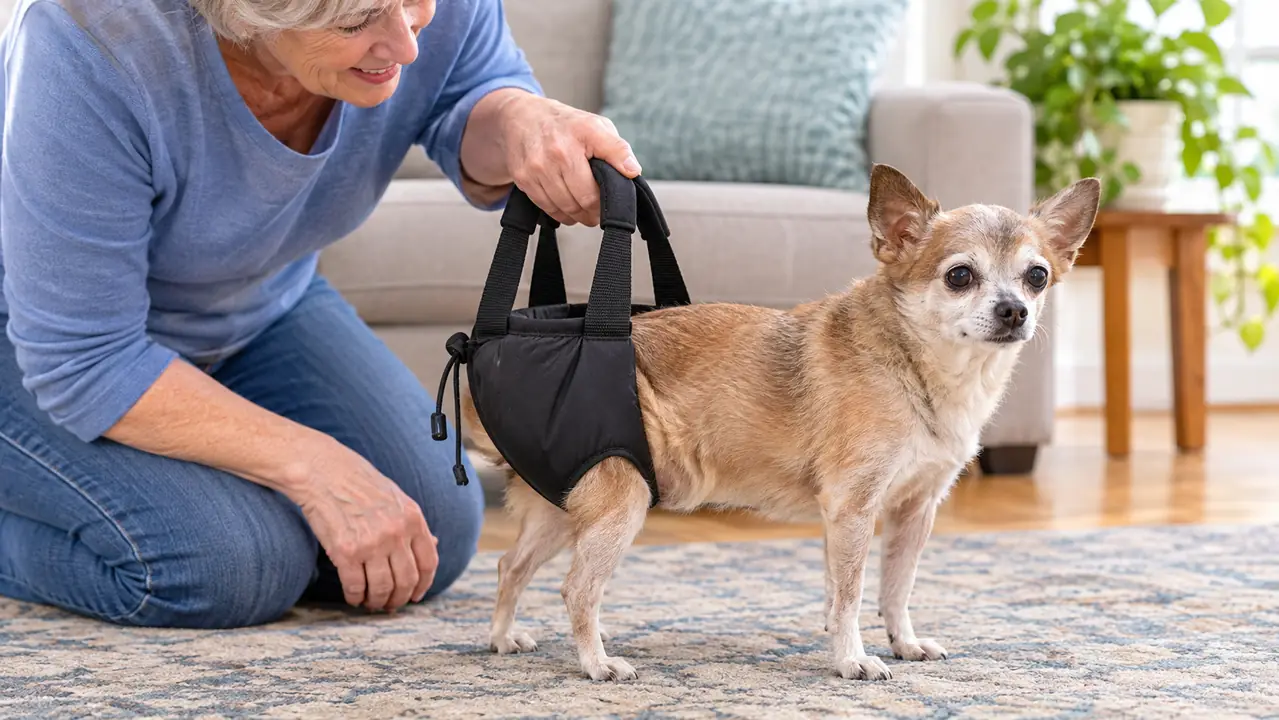
Here is the part the product page does not say out loud: this is a rear-end sling. It holds up the back half of your dog and nothing else. If you are picturing something that carries the whole dog, or something your dog wears around the house all day like a little vest, that is not this. It is a strap of nylon with a drawstring, padded handles, and a storage bag, and it does one job.
I bought the PICK FOR LIFE lift harness in June, five months ago, in size Small, which is the smallest size on the listing. My dog is a 13 year old Yorkshire Terrier named Pepper, about 6 pounds, with arthritis in his hips and a loose kneecap on the left back leg that Dr. Salazar diagnosed when he was 12. I am not a vet. I am a retired dental office manager in Tucson who has had small dogs most of her life and who has gotten very particular about what I put on an old dog's body. So this is what I found, including the parts I did not expect.
The Quick Verdict
A well-made rear-only sling that genuinely helps on a bad morning, held back by a real sizing gap for toy breeds and a drawstring that has to be cinched nearly shut on a 6 pound dog.
Amazon Check Today's Price →If your dog's back legs quit before his front ones do, this is the strap that buys you a few minutes
It supports the hind end only, which is exactly what a dog with hip arthritis and a slipping kneecap needs on the one step at the kitchen door. Check the size chart against your dog's actual girth before you order.
Amazon Check Today's Price on Amazon →What the Listing Says and What It Actually Means
The title on Amazon is a mouthful: Adjustable Dog Lift Harness for Small Dogs Hind Leg Support Weak Legs Aid. Buried in that is the honest description. Hind leg support. Rear end. That is the whole product.
The specs list the materials as nylon, the closure as a drawstring, the included components as the sling, the handle, a storage bag and a user guide, and the whole thing weighs 4.8 ounces. It is machine washable. The warranty description says 7 days, which I would read as a return window rather than anything resembling a guarantee, and I would not expect much beyond that.
What those specs do not tell you is the thing you most need to know, which is how much room there is in the sling when you cinch it down. I will get to that, because it is the single biggest issue I have with the PICK FOR LIFE harness and the reason I am not giving it five stars.
How I Use It, and How Often
About twice a week. Not daily. I want to be clear about that because a lot of reviews make it sound like a dog wears this from morning to night, and mine does not.
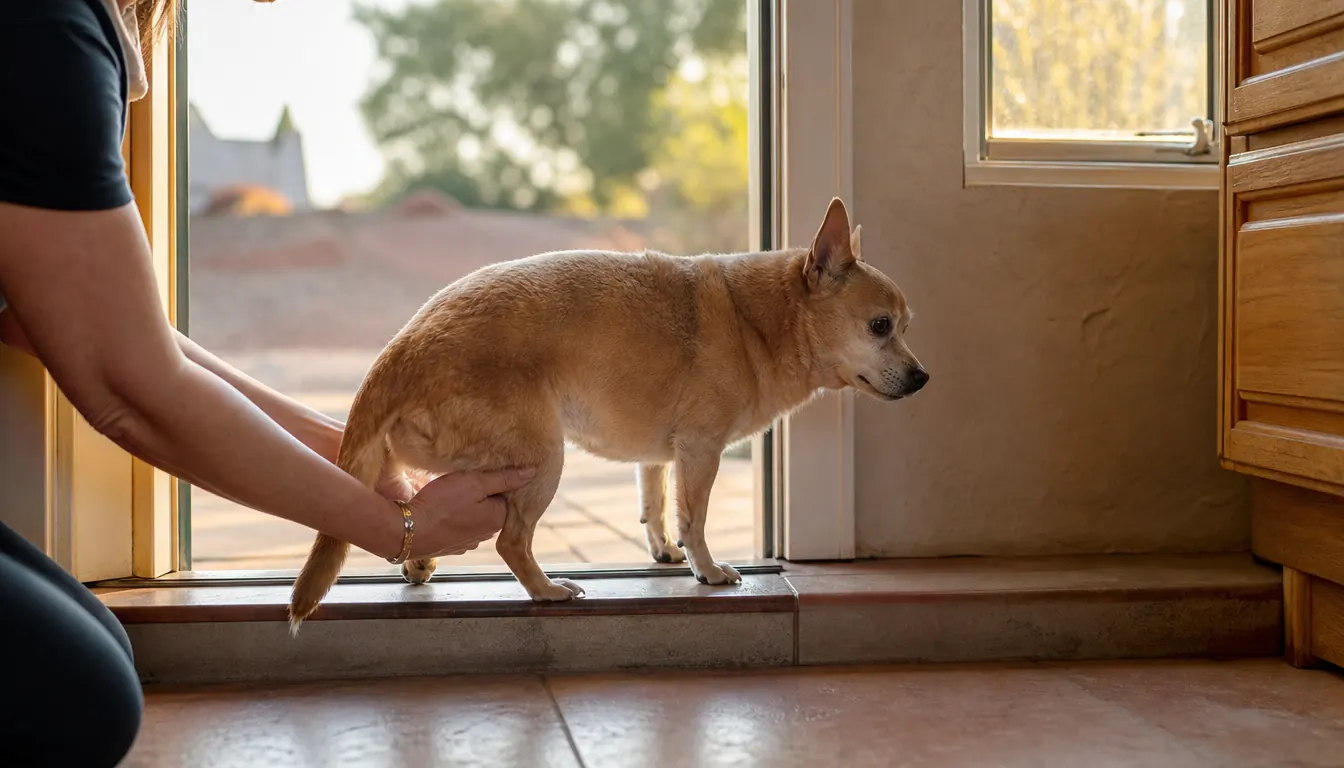
There are two situations where it comes off the hook by the kitchen door. The first is the one step down from the kitchen to the back patio. Pepper can do that step on his own most days, slowly, with a pause at the top. On a bad morning he stands there and looks at it and does not commit. That is when I slip the sling under him and take his weight for the two seconds it takes him to get down. The second is the walk on a bad morning, the first ten minutes of it, when his back legs are stiff and he is still working them loose.
Let me give you one morning so you know the scale of it. Early July, a Tuesday, not quite seven in the morning and the thermometer on the patio already reading 88. Pepper came out of his bed stiff, which is normal, and made it through breakfast fine. Then he got to the kitchen door, put his front feet on the threshold and stopped. He looked at the step, looked back at me, and did not move for a good fifteen seconds. I got the sling off the hook, cinched it under him, and he went down in one motion instead of the three-legged hesitation. Whole thing took maybe twenty seconds. That is the job.
The rest of the time it stays in the storage bag. That is not a complaint. It is what a tool like this is for.
I started using it because of what I was doing instead. I was scooping him up under the belly, one arm across his middle, and he hated it. He would stiffen and pull away. The sling under the rear is a different thing entirely. He stands still for it now, which took about three days to establish, and I think that is because nothing is pressing on his sore parts.
The Sizing Problem Nobody Warns You About
Size Small is the smallest size on the listing. On a 6 pound Yorkie it is roomy. Not unusable, but roomy, and the drawstring has to be cinched almost all the way closed before the sling sits snug enough to actually hold him rather than slide underneath him.
That is a real design gap, and it is the thing I would tell another toy breed owner first. The closure is a drawstring, so you do get adjustment, and I do not have a dog slipping out of it. But there is a lot of gathered fabric bunched up when I cinch it down that far, and the first week I was adjusting it constantly, mid-step, which is not what you want when you are steadying a dog on a step.
I measured him before I ordered, which I would recommend, though it did not fully solve it. A cloth tape around the widest part of his hindquarters, just in front of the back legs, came to about thirteen inches. Size Small is the smallest size listed, so there was no smaller option to move down to. What I did instead was fold the excess fabric to one side and hold it against the handle with my thumb, which worked but meant one hand was doing two jobs. After about ten days the cord settled into a spot that held and I stopped fussing with it.
If your dog is under about 8 pounds, expect to spend a week learning where the drawstring needs to sit for your particular dog, and expect to re-tie it more than once. It settles. It just is not plug and play out of the package the way the photos suggest.
I was scooping him up under the belly, one arm across his middle, and he hated it. He would stiffen and pull away. The sling under the rear is a different thing entirely.
What It Does Well
The handles are the best part. They are padded, and there are two of them, so I can hold one in each hand and take his weight evenly instead of cocking my wrist sideways. I am 63 and my hands are not what they were. That detail matters more than I expected it to, and it is the reason I keep reaching for this instead of a towel under the belly.
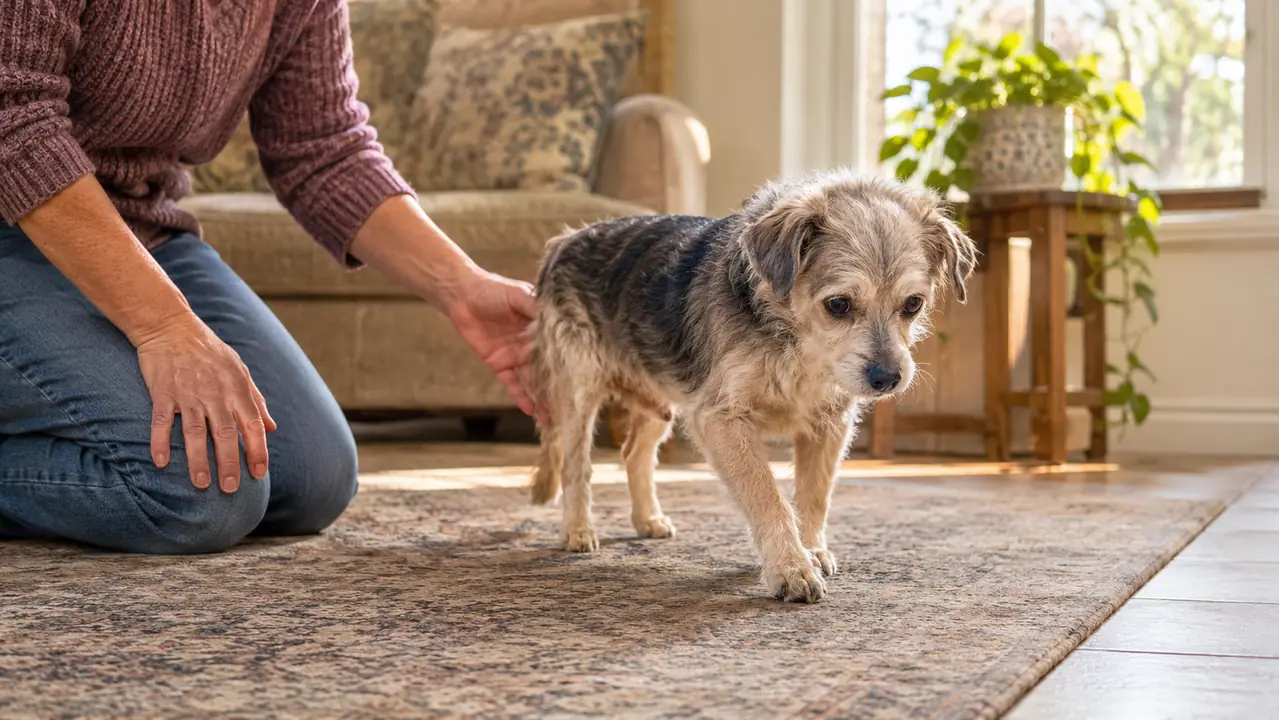
The walk is the other place it earns its keep. On a bad morning we do the block, and the first stretch is the rough one, before his legs warm up. I keep the sling on him for that stretch and take maybe a third of his weight, just enough that his back feet are still doing the work but not all of it. By the time we reach the corner he is moving on his own, so I take it off and carry it the rest of the way. Walking with it is not elegant. I am hunched over at his pace with one hand down at his rear, and the neighbors have gotten used to the sight.
The nylon is sturdy and it has held up through five months of twice-a-week use with no fraying, no seam separation, and no stretched-out stitching where the handles meet the body of the sling. It goes in the machine and comes out fine. I let it air dry.
It is also genuinely small enough to keep out rather than buried in a closet. It lives in the storage bag on a hook by the kitchen door and that is the difference between a tool you use and a tool you own. If it were a bulky thing I had to dig for, I would not bother, and Pepper would be doing that step unsupported.
What It Does Not Do
It does not support the front end at all. When Pepper's front legs are the tired ones, this gives me nothing. On those days I use two hands and my own arms and we take it slowly.
It is not something he wears around the house. That is by design, but I want to name it because the product photos can leave the impression that a dog keeps it on. He does not. It goes on, he does the step or the first few minutes of the walk, it comes off.
And it has not changed his condition. His arthritis is his arthritis. The loose kneecap is still loose. He still does not jump onto the sofa or the bed, and that is what the stairs are for. What the PICK FOR LIFE sling does is make one specific moment in our day safer for both of us. Nothing more, and I would be doing you a disservice to dress it up bigger than that.
What I Liked
- Padded handles on both sides let you carry the weight evenly instead of twisting one wrist
- Nylon held up through five months of use with no fraying or seam separation
- Light enough at 4.8 ounces to keep by the door in its storage bag, so it actually gets used
- Machine washable, which matters more than it sounds on a tool used near a dog's hindquarters
- Pepper stands still for it, unlike being scooped under the belly
Where It Falls Short
- Size Small is the smallest offered and still roomy on a 6 pound dog
- The drawstring has to be cinched almost fully closed on a toy breed, which bunches fabric and needs re-adjusting at first
- Rear support only, nothing for the front legs
- The 7 day warranty description is not much of a safety net
- Not wearable around the house, so it is a tool you pick up and put down
How It Compares to Just Using a Towel
Before I bought this I did the towel-under-the-belly thing for a couple of weeks, because that is the free version and I am not made of money. It works, in the sense that you can take some weight off. What it does not do is stay put. A towel bunches, it slips forward or backward depending on the angle, and you end up gripping it with both fists in a way that puts your shoulders in a bad position.
For the first couple of weeks I used a hand towel, folded in thirds, and the fold is what made it fail. A folded towel under the belly puts a hard ridge right where you are trying to be gentle, and it rolls. There was one morning on the patio step where it slipped out from under him mid-step and he sat down hard on the concrete. He was fine, but I felt sick about it, and that was the morning I got online and ordered the sling. A bath towel is worse, too much fabric to manage with one hand while a dog is waiting on you.
I have never used a separate rear support sling, so I cannot compare it to one, and I would be making things up if I did. What I can tell you is that I looked at the dimensions and the listed components for a couple of them and the shape of the job is the same. If you already own a sling that works, you do not need this. If you are using a towel and swearing at it, this is the upgrade.
I also ruled out a ramp entirely, because our living room is not big enough to give up the floor space, and Pepper would not have trusted it anyway. The foam stairs solved the sofa problem. The sling solved the step problem. Those are different problems and I have stopped expecting one product to fix both.
Who This Is For
Owners of small dogs who have lost the back end but not the front. Dogs with hip arthritis, a slipping kneecap, or a rear leg injury where the vet has said the back legs need support and not total restraint. Dogs in the 8 to 20 pound range, where the sling will fit without the drawstring being cinched to its limit.
It is also for the person doing the lifting. If you are older, or your hands or shoulders are not what they were, the padded double handles are the reason to pick this over improvising. That is a real consideration and I do not think it gets said often enough in dog mobility gear.
Who Should Skip It
If your dog is under about 6 or 7 pounds, call the sizing into question before you order, and be ready to fiddle. If your dog needs front end support, or full body support, this is the wrong shape of tool and you will be frustrated. If your dog cannot bear weight on the back legs at all, that is a conversation with your vet about a cart or a proper harness, not a nylon sling from an online listing.
And if you are looking for something that will make an old dog young again, skip it, and skip every other product in this category too. Nothing on the market does that. What you can buy is a safer Tuesday morning at the kitchen door. That is what this is.
The Practical Stuff: Washing, Storing, and Getting Your Dog to Accept It
It washes in the machine and I have done that maybe six times now. No shrinkage, no color running, handles still padded. I air dry it on the back of a chair because I am cautious with nylon.
On acceptance, which is the part people ask me about: Pepper took a few days to stand still for it. What worked was putting it under him while he was already standing and giving him a treat, then taking it away, several times, before I ever tried to use it to actually lift. By day three or four he stopped sidestepping. I would not try to force a dog into it on the first go. Give it a week of short, boring, treat-filled exposures.
One more thing worth saying plainly. If your dog is showing new weakness in the back legs, or a new limp, that is a vet appointment before it is a purchase. Pepper's issues were diagnosed before I bought any gear, and Dr. Salazar has seen him since. Gear supports a diagnosis. It does not replace one.
For the step your dog stands at and will not take, this is what I reach for
Rear-end support only, padded handles, 4.8 ounces, machine washable. Five months of twice-a-week use on a 6 pound senior dog. Check the size against your dog's girth, and ask your vet first if the weakness is new.
Amazon Check Today's Price on Amazon →